
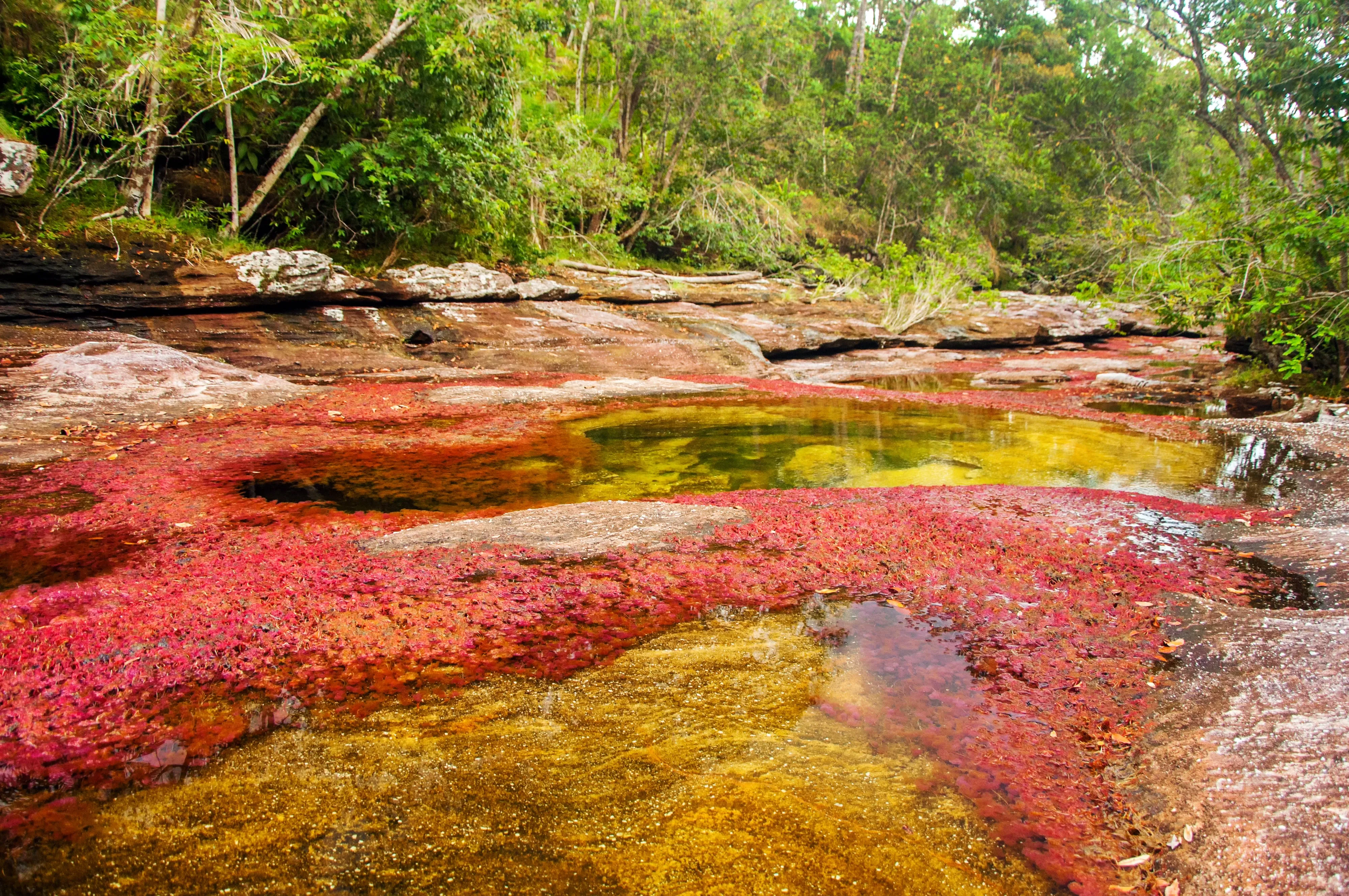
For most of the year the riverbed at Caño Cristales looks like any other clear stream running over rock. For a few months it turns red, pink, yellow, and green at once, and people fly across the country to stand next to it. That window is open now, and it closes in December.
It is also one of the most tightly regulated places to visit in Colombia, in ways that catch people out. Parques Nacionales publishes an annual visitor handbook for La Macarena, and most of what follows comes from the 2026 edition rather than from tour operator copy.
The Season
Parques Nacionales Naturales, the mayor’s office of La Macarena, the regional environmental authority Cormacarena, and the Macarena tourism value chain opened the 2026 season on May 29, running through December. The slogan is “Naturalmente Responsable,” which in practice means a list of rules rather than a marketing line.
The river sits inside the Sierra de La Macarena National Natural Park, more than 600,000 hectares in Meta department, in the Orinoquía.
Why It Turns Colored
The color comes from an aquatic plant, Rhyncholacis clavigera, known locally as macarenia, endemic to this river system. It shifts through green, yellow, pink, and red depending on the natural rain cycle: it needs enough water to stay submerged, and enough light reaching it through that water. Too little rain and the plant dries out. Too much and the river runs deep and fast enough that light does not reach the bed.
That is why nobody can promise you a specific week. The river performs on its own schedule, and any operator guaranteeing peak color on fixed dates is selling something they do not control.
The Trails Are Harder Than the Photographs Suggest
This is the part most write-ups skip. The colored-river sector, Cristales de Colores, has five authorized trails, and Parques Nacionales publishes the distance, walking time, difficulty, and a daily cap for each:
- Salto del Águila, 9.7 km circular, about 7 hours, high difficulty, 75 people a day.
- Los Pianos, 6.9 km circular, about 7 hours, high difficulty, 62 people a day.
- Intermedio, 4.2 km circular, about 5 hours, medium, 42 people a day.
- Caño Escondido, 4.2 km circular, about 5 hours, medium, 37 people a day.
- Caño Cajuche, 1.2 km linear, about 2 hours, low, 19 people a day.
A sixth trail, Los Pailones, sits in the neighboring Cristales Selva sector at 9.4 km circular, and there are further authorized routes at Mirador and Cristalitos, Raudal de Angosturas I, Caño Piedra, and the Laguna del Silencio, which alone has nine trails with caps ranging from 7 to 94 people a day.
Two things follow. First, those daily caps are small, and they are the reason the whole season expects only a few thousand visitors. Second, this is a hiking trip in tropical heat, not a viewpoint you are driven to. Note also that for the Caño Cristales trails you walk roughly one extra kilometer each way, from the access road at the Caño Cajuche visitor center to the start point.
What It Actually Costs to Walk In
Here is the detail that surprises people: entry rights are charged by three separate bodies, and you pay all three.
For a foreign visitor in 2026, the national park charges COP 78,500 (about USD 26), Cormacarena charges COP 75,080 (about USD 25), and the municipality charges COP 66,000 (about USD 22). That comes to roughly COP 219,580 (about USD 72) per person in entry rights alone, before the flight, the guide, the accommodation, or the food.
Colombian nationals, residents, and Andean Community members pay less at each step: an adult over 25 pays COP 51,500 (about USD 17) for the park, COP 49,251 (about USD 16) to Cormacarena, and COP 44,000 (about USD 14) to the municipality. Younger adults and children pay reduced park and Cormacarena rates. People who live in La Macarena itself pay no entry rights at all.
On top of that, accident insurance with visitor assistance is mandatory, and a guide is compulsory at a ratio of one guide per nine visitors.
The Rules That Catch People Out
Do not wear sunscreen, insect repellent, moisturiser, or makeup on the trails.
The chemicals damage the macarenia, the plant the entire trip exists to see. This means planning sun and insect protection around cover instead: long sleeves, a hat, and sunglasses are listed as indispensable.
Parques Nacionales also asks visitors to be vaccinated against yellow fever before traveling, to wear closed shoes with grip rather than sandals, to carry a refillable bottle or hydration pack since single-use bottles are not permitted, to avoid touching petroglyphs and pictograms, to carry identification, and to pack out their own rubbish.
Booking Is Not a Same-Day Affair
Visits are arranged through an authorized local travel agency, which files your entry request with all three authorities. The institutions have three to five working days to respond, and the handbook is blunt that a traveler who turns up without a reservation is subject to whatever capacity is left, and that visiting Caño Cristales or Raudal de Angosturas I on the day you arrive in town will not be possible.
Departures run from the Inderena port between 7:00 a.m. and 10:00 a.m., leave the site around 4:00 p.m., and return to town by about 6:00 p.m.
Parques Nacionales publishes the list of authorized operating agencies in La Macarena, with their tax numbers and contact details, in the same handbook. It also advises checking, before you pay anyone, that the attractions being sold to you are actually authorized, since not every site marketed in the area is.
The Advisory Position
The UK government advises against all but essential travel to the surrounding region, and makes a specific exception for Caño Cristales with a condition attached.
The UK Foreign, Commonwealth and Development Office advises against all but essential travel to “the Ariari region of southern Meta, except for Caño Cristales.” It attaches a specific instruction: “If travelling to the tourist site of Caño Cristales, travel by air from the town of La Macarena with a reputable tour company.”
The US State Department’s advisory places Colombia at Level 3, “reconsider travel,” as of March 31, 2026.
Those two sets of guidance point the same way. The FCDO’s “reputable tour company” and the park authority’s roster of carded local agencies are describing the same requirement from different directions, and it is the requirement the whole trip hangs on.
We do not tell readers that remote places in Colombia are safe, and this post is not doing so. What the advisory does is carve out a specific site under a specific mode of access. Our Colombia safety guidelines and is Colombia safe pages cover the wider picture, and advisories are revised through the year, so read them at your own dates.
If You Are Considering It This Season
The window runs to December, and this is not a spontaneous trip. It needs a flight to a small town, a package booked through an authorized agency at least a week ahead, a guide, a yellow fever vaccination, mandatory insurance, three sets of entry fees, and legs that will carry you up to ten kilometers over broken ground in the heat, without sunscreen.
It also rewards being honest about what you want. If the appeal is a specific photograph, the river may not cooperate on your dates. If the appeal is a few days in one of the least-visited landscapes in a heavily-visited country, walking past petroglyphs and macaws, it will deliver that regardless of how strongly the plant is showing. Our nature and wildlife guide covers where else that instinct leads in Colombia.
We are publishing a full Caño Cristales guide later in the season. This post is the timing and the fine print.
Sources checked August 12, 2026, against the ABC 2026 visitor handbook published by Parques Nacionales Naturales and the season announcement dated May 29, 2026. Fees are set annually and capacities can change within a season. Confirm both with the authorities and your operator before booking.
Sources
- Parques Nacionales Naturales: ABC 2026, the official visitor handbook for the regulated ecotourism sites in La Macarena, Meta (entry fees under Resolution 551 of 2025, trail distances and daily capacities, entry rules, and reservation process)
- Parques Nacionales Naturales: La Macarena opens the Caño Cristales season under “Naturalmente Responsable”
- Parques Nacionales Naturales: Sierra de la Macarena National Natural Park
- UK FCDO: Colombia regional risks
- US State Department: Colombia travel advisory