
Updated
On this page
Updated October 1, 2026: the Coffee Region after the August earthquake.
A magnitude 7.4 earthquake struck western Colombia on August 10, 2026, and Risaralda, Quindío, and Caldas were among the departments damaged. By early September the region was receiving visitors again: Pereira’s Matecaña airport reopened to commercial flights on August 26, Panaca, Bioparque Ukumarí, and the Parque Nacional del Café reopened after structural checks, and Salento’s town hall said there were no restrictions on visiting. That is not the same as saying the recovery is over. Reconstruction will take years, and some hotels were still closed in late August. Pereira’s airport reopened with fewer flights than before, so check current schedules into Pereira, Armenia, and Manizales before you book, and confirm road conditions with your hotel or driver. Our September recovery update sets out what has reopened, with sources.
The guide below was written before the earthquake.
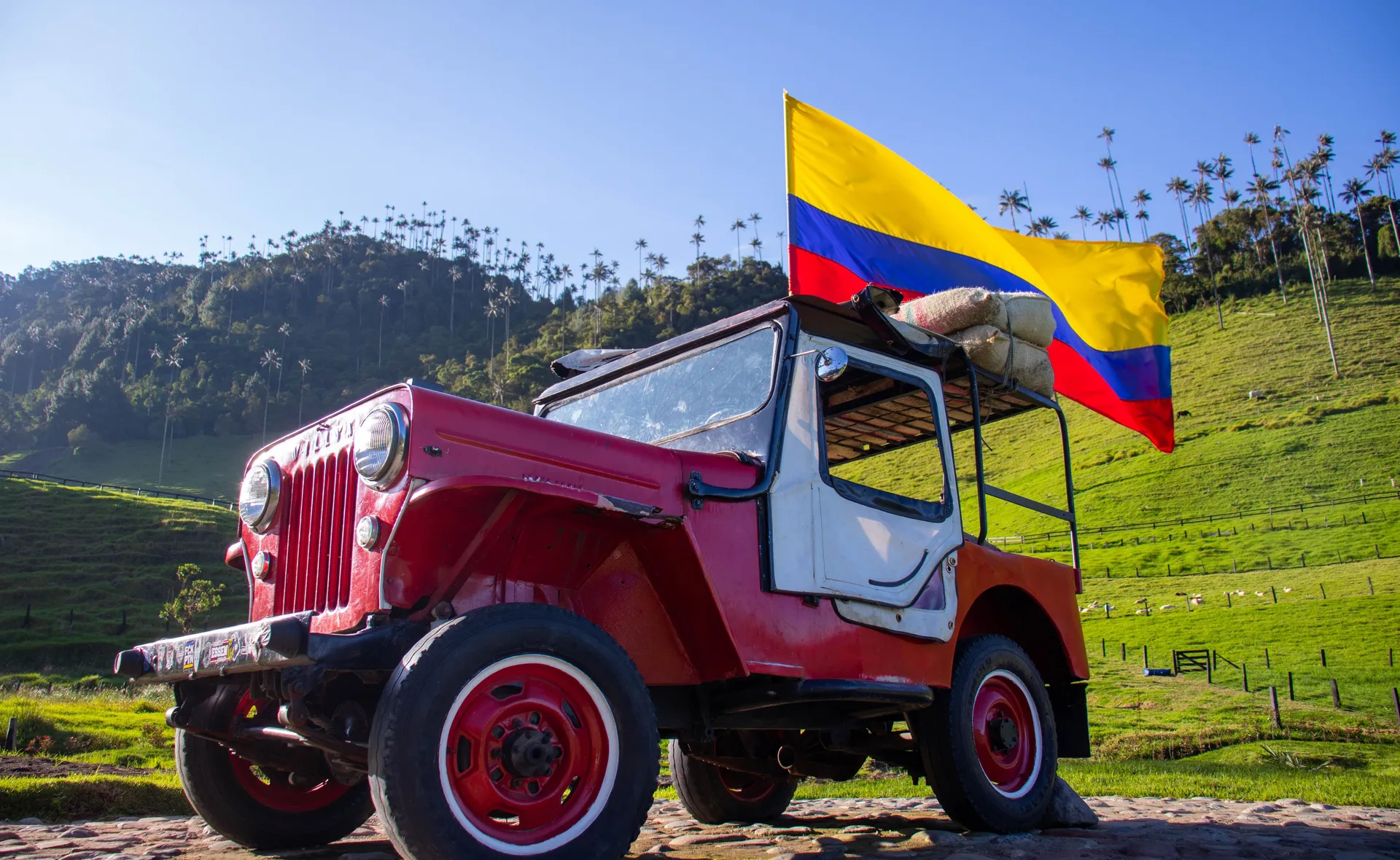
The Coffee Region is not a place you move through the way you do a big city. It is rural and folded across hills, its towns strung between coffee farms, valleys, and mountain ridges, so getting around is part of the experience rather than a chore to rush through. The classic image of the region, a bright Willys jeep piled with passengers and luggage grinding up the road to the Cocora Valley, is transport and sightseeing rolled into one. Distances are short, but the roads are winding, so plan for the scenery to slow you down.
It helps to picture the region in two layers. The three departmental capitals, Pereira, Armenia, and Manizales, are the transport hubs: they hold the airports, the intercity bus terminals, plentiful metered taxis, and the ride apps. The smaller towns most visitors travel for, above all Salento and Filandia, run on jeeps, frequent local minibuses, and cash. This guide covers how to move between and within both layers. For how to reach the region in the first place, from Bogotá or Medellín by plane or bus, see our complete Coffee Region travel guide.
Willys Jeeps
The Willys jeep is the unofficial mascot of Quindío. These are World War II surplus vehicles, lovingly kept running for decades, that colonized the coffee hills as the workhorses of farm life. Locals call the tradition the Yipao, and you will still see jeeps stacked impossibly high with plantains, coffee sacks, or furniture. For visitors, they double as shared transport around Salento and, most famously, the ride out to the wax palms.
Jeeps to the Cocora Valley leave from Salento’s main plaza, the Plaza de Bolívar. They run on a fill-and-go system rather than a fixed timetable, departing when the seats and running boards are full, roughly every 15 to 60 minutes from around 6:00 to 6:30 AM. The ride to the Cocora trailhead takes about 20 to 30 minutes and costs roughly COP 10,000 to 12,000 round trip (about USD 3 to 4), paid in cash to the driver. Jeeps from the same plaza also serve nearby coffee fincas, a ride of around 15 minutes to the closest farms.
On weekends and holidays the queue in the plaza forms early and moves in waves, so arrive by mid-morning if you want an unhurried start on the trail. Keep small bills handy, and hold on: the standing spots on the back bumper are a rite of passage, but the mountain road is bumpy.
Buses Between Towns
Frequent minibuses and colectivos knit the towns and cities together, and they are cheap. There is rarely a strict schedule; buses leave often and fill up, and the last departures tend to be in the early evening, so do not leave an intertown hop until after dark.
- Salento to Armenia: small buses leave roughly every 20 minutes from around 5:20 AM to 8:00 PM, take about 45 to 50 minutes, and cost roughly COP 4,500 (about USD 1.40). Armenia’s terminal is the usual transfer point for onward long-distance buses.
- Salento to Pereira: Expreso Alcalá runs this route roughly hourly, with Flota Occidental adding a few daily departures. The trip takes about an hour and costs roughly COP 11,000 to 13,000 (about USD 3 to 4), arriving at Pereira’s main Terminal de Transportes.
- Filandia: the village connects most directly through Armenia, with a direct bus of about 45 minutes to an hour for roughly COP 4,500 (about USD 1.40), and there are also connections via Pereira. A direct jeep and minibus link runs between Filandia and Salento in roughly 30 to 45 minutes, which saves backtracking through a city if you want to see both towns.
Fares are paid in cash to the driver or at the small terminal window, and prices creep up year to year, so treat these as a guide and confirm on the day.
Taxis and Ride Apps
In the three cities, taxis are everywhere and inexpensive, and the ride apps work. Both Uber and DiDi operate in Pereira, Armenia, and Manizales, though the pool of drivers is thinner than in Bogotá or Medellín, so DiDi often makes the better backup when Uber is quiet, and inDrive, the bid-based app, is also used across Colombia. Booking in an app gives you a fixed, upfront price and a digital record, which is worth having.
The picture changes in the small towns. In Salento and Filandia, app coverage is unreliable to nonexistent, and you fall back on the Willys jeeps, the local minibuses, and taxis arranged at the plaza or through your accommodation. For any trip beyond city limits, meters are not used; agree the fare before you set off. Carry small bills, since drivers rarely break large notes. A working phone with data makes booking and mapping far easier, so it is worth sorting a local SIM or eSIM before you arrive; see our guide to staying connected in Colombia.
Airport Transfers
The region has three airports, and which one you use depends on where you are based: Pereira (PEI, Matecaña), Armenia (AXM, El Edén), and Manizales (MZL, La Nubia). Our complete Coffee Region travel guide covers flight routes and which airport suits which base.
- Pereira (PEI) to Salento: about 44 km and roughly an hour and 15 minutes by road. A pre-booked private transfer or airport taxi runs roughly COP 150,000 to 240,000 (about USD 47 to 76), and app rides land in a similar range. The budget route is a taxi to Pereira’s bus terminal, then the hourly Salento bus.
- Armenia (AXM) to Salento: roughly an hour by road. A direct taxi costs around COP 95,000 to 150,000 (about USD 30 to 47). To save money, take a short taxi to Armenia’s terminal, around COP 25,000 (about USD 8), then a Salento minibus for a few thousand pesos.
- Manizales (MZL) into the city: La Nubia sits only about 8 km from the center, a short taxi ride of roughly 20 minutes, though the ridge-top runway is prone to fog, so build in a buffer for delays.
For a family or small group, a single private transfer can work out cheaper and calmer than splitting across taxis, especially after a long travel day. As always beyond the city, confirm the price before you get in.
Renting a Car or Scooter
A rental car earns its keep if you want to roam beyond the main towns on your own schedule, linking fincas, the Santa Rosa de Cabal hot springs, and a string of villages without waiting on minibuses. Rental desks cluster at the Pereira and Armenia airports, with the usual names such as Hertz, Avis, Localiza, and Sixt, and rates commonly start around USD 40 to 50 a day. Within Salento or Filandia themselves you do not need a car; both are small and walkable, and parking on the cobbled center streets is tight.
The region’s main roads are mostly paved and in reasonable condition, but this is mountain driving: expect tight switchbacks, sudden fog, slow trucks on the climbs, and plenty of motorbikes and cyclists sharing the lane. Drive in daylight, keep your speed down on the bends, and give yourself more time than the distance suggests. Scooters and motorbikes can sometimes be rented informally in the towns, but availability is limited and inconsistent, so confirm on the ground, check what insurance and license are required, and satisfy yourself about the machine before you take it out.
For most visitors, the honest answer is that you can see the headline sights, Cocora, a coffee farm, and a second village, entirely on jeeps, buses, and the odd taxi, and only reach for a rental when you genuinely want to wander wider. Whichever way you travel, the getting around here is half the pleasure. Once you are settled on a base, our Salento and Cocora Valley guide picks up where this one leaves off.