
Updated
On this page
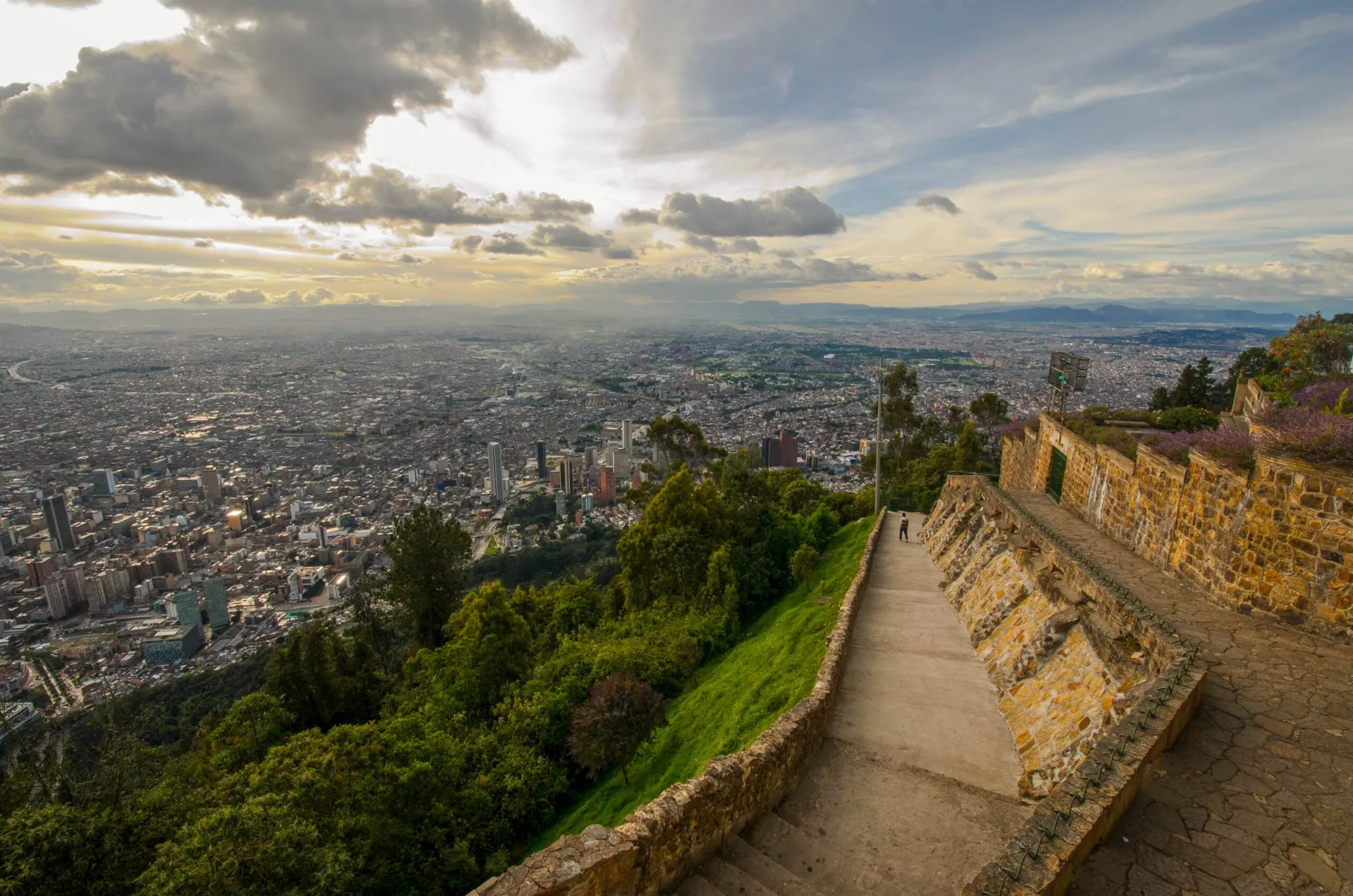
Bogotá sits on a high plateau in the Andes, a sprawling capital of nearly eight million people with colonial streets at one end and glass towers at the other. It is cooler, wetter, and more businesslike than the Caribbean coast, and it rewards visitors who arrive knowing a few things: how the street grid works, which neighborhood suits them, what the altitude does in the first two days, and which habits keep a trip running smoothly.
This guide is the first-day orientation. Where a subject deserves more room, it points you to the page that covers it in full: where to stay, getting around, and things to do.
About Bogotá
Bogotá is Colombia’s political, economic, and cultural center, and its El Dorado airport is the country’s busiest. Many visitors treat the city as a stopover on the way to the coast or the Coffee Region. Those who stay a few days find one of South America’s strongest museum cities, a serious food scene, and neighborhoods that feel like different towns.
The historic center, La Candelaria, holds the Gold Museum, the Botero Museum, and the main square, Plaza de Bolívar. Further north, Chapinero, the Zona Rosa, and Usaquén are where much of the city’s dining, nightlife, and weekend browsing happens. Above it all is Monserrate, the mountain with the church on top, reached by cable car or funicular and visible from almost everywhere.
Quick Facts About Bogotá
| Fact | Value |
|---|---|
| Population | About 7.9 million (city, 2026 projection by DANE, Colombia’s statistics agency) |
| Altitude | About 2,600 meters (8,500 feet) |
| Language | Spanish |
| Currency | Colombian peso (COP) |
| Time zone | UTC-5 all year (Colombia does not use daylight saving time) |
| Emergency number | 123 |
Bogotá Spanish is often described as clear and fairly slow, which helps if you have some Spanish. In the tourist areas you will find English in hotels and some restaurants, but not reliably in taxis, shops, or markets.
Understanding Bogotá’s Layout
Bogotá is easier to navigate than its size suggests, because most of it runs on a numbered grid anchored to the mountains. The Cerros Orientales, the Eastern Hills, run along the city’s eastern edge. If you can see them, you know which way is east.
- Calles (Cl.) run east-west, and their numbers rise as you go north.
- Carreras (Cra.) run north-south, parallel to the mountains, and their numbers rise as you go west, away from the hills.
So if you are at Calle 10 with Carrera 5 and need Calle 20 with Carrera 7, you head north, and slightly west.
Key areas to remember:
- La Candelaria: the historic center, in the southeast against the hills
- Chapinero: north of the center, with Zona G’s restaurants on its hillside
- Zona Rosa (Zona T) and Parque 93: the main nightlife and shopping area, further north
- Usaquén: a former village in the far north, best known for its weekend market
House Numbering System
An address tells you where to go. “Calle 82 # 11-22” means the building is on Calle 82, about 22 meters from the corner with Carrera 11. Read it as: the street you are on, the nearest cross street, then the distance from that corner. Taxi drivers and ride-hailing apps both work from this system, so having the full address written down saves a lot of explaining.
Key Districts
These are the districts where most visitors spend their time. For a full comparison of where to base yourself, with prices, see where to stay in Bogotá.
La Candelaria (Historic Center)
La Candelaria is Bogotá’s colonial heart: cobblestone streets, painted houses, and most of the museums a first-time visitor wants to see, including the Gold Museum and the Botero Museum. Plaza de Bolívar, ringed by the cathedral, the Capitol, and the Palace of Justice, is the city’s main square.
Explore it in daylight, when the museums are open and the streets are busy. The streets empty quickly after dark, when the area carries more risk, so take a taxi or app ride back in the evening rather than walking. Keep your phone out of sight in the crowds around Plaza de Bolívar.
Chapinero
Chapinero is a large, mixed district north of the center, with a young, lively feel. Its hillside section, Chapinero Alto, holds Zona G (the “Gourmet Zone”), where many of the city’s best restaurants cluster. The main dining and nightlife streets stay busy late and are among the city’s lower-risk areas, but quieter side streets carry more risk after dark, so take a taxi or app ride between venues rather than walking them.
Zona Rosa/Zona T
The Zona Rosa, with the pedestrian Zona T at its center, is Bogotá’s upscale entertainment district: international hotels, shopping centers, and the city’s densest concentration of bars and clubs. Its well-patrolled streets are among the city’s lower-risk areas at night, which makes it a reliable choice for night owls. The risks to watch for are pickpocketing in busy bars and spiked drinks, so keep your phone close and never leave a drink unattended.
Usaquén
Usaquén was a separate colonial village until the city grew around it, and its small square and low buildings still feel that way. Its flea market, the Mercado de las Pulgas de Usaquén, runs on Saturdays, Sundays, and holiday Mondays from 9:00 AM to 5:30 PM, and the restaurant streets around the square are busy all weekend. Its relaxed, family-friendly atmosphere makes it one of the lower-risk areas to explore, especially by day and during the market. In the evening, stay around the main square and the restaurant streets near it.
Weather and When to Visit
Bogotá has no summer or winter. At this altitude it is cool all year, with an average temperature of around 13°C (55°F): mornings are fresh, a sunny afternoon can feel warm, and evenings turn cold. What changes through the year is the rain.
By Season
- Rainier months: roughly April to May and October to November, with April and October usually the wettest. Rain tends to come as afternoon downpours rather than all-day drizzle.
- Drier months: December to February, and to a lesser extent July and August. December and January are also peak travel season, when flights and hotels cost more.
Whatever the month, pack layers and a rain jacket. A sunny morning can become a cold, wet afternoon within an hour, and the sun is strong at altitude even when the air is cool, so bring sunscreen too.
Altitude Considerations
Bogotá sits at about 2,600 meters (8,500 feet). The US Centers for Disease Control and Prevention (CDC) notes that unacclimatized travelers sleeping at 2,450 meters (8,000 feet) or higher are at risk of altitude illness, so many visitors arriving from sea level feel it, at least for a day or two.
Tips for Altitude Adjustment
- Take the first day easy. Plan light sightseeing for your first 24 to 48 hours.
- Go easy on alcohol. The CDC advises avoiding it for the first 48 hours at altitude.
- Drink water and eat lightly at first.
- Save Monserrate for later. It rises to over 3,100 meters (10,000 feet), so leave it until you have been in the city a couple of days.
The usual symptoms of acute mountain sickness are a headache, often with tiredness, dizziness, nausea, or loss of appetite, a bit like a hangover. Mild symptoms usually ease within a day or two as you adjust. Seek medical help if symptoms get worse despite rest, or if you develop confusion, unsteadiness, or serious breathlessness. You will also see coca tea (mate de coca) offered as a local remedy. It is legal in Colombia, but it can show up in a drug test, and you should not take it home, since coca leaf is illegal in many countries.
Essential Safety Tips
The precautions that matter in Bogotá are specific: risk is higher after dark, in quiet streets, at street-side ATMs, and in taxis hailed off the street. The UK Foreign, Commonwealth and Development Office (FCDO) names Bogotá among the major cities where “pickpocketing, mugging and armed robbery are a problem” (checked October 1, 2026), and our Is Colombia Safe? page compares the current government advisories. These do’s and don’ts make the most difference.
Do’s
- Use ride-hailing apps, or taxis called by your hotel or restaurant
- Keep your phone out of sight on the street, and step into a shop or café to check directions
- Stay in well-lit, busy areas after dark, and take a ride rather than walk anything but short distances at night
- Carry only the cash you need for the day, and leave your passport in the hotel safe with a copy on your phone
- Use ATMs inside shopping centers or banks, in daylight
Don’ts
- Wear expensive jewelry or leave a phone on a café table
- Walk alone at night through quiet streets, particularly in unfamiliar areas
- Resist if someone tries to rob you; hand over what they want
- Accept drinks, cigarettes, or snacks from strangers, or leave a drink unattended
- Hail taxis on the street, especially at night
Getting Around
Bogotá is big and its traffic is heavy, so how you move around shapes your day. This is a quick overview; our guide to getting around Bogotá covers every option, including the airport.
TransMilenio (Bus Rapid Transit)
TransMilenio is the city’s network of bus lines running in dedicated lanes, with stations in the middle of the main avenues. A ride costs COP 3,550 (about USD 1.10) in 2026, paid with a rechargeable TuLlave card sold at stations. It is cheap and fast for long trips, but very crowded at rush hour (roughly 7:00 to 9:00 AM and 5:00 to 7:00 PM), when pickpockets work the packed buses. Travel outside those hours if you can, and keep your phone and wallet in a front pocket.
Taxis
Ride-hailing apps such as Uber, DiDi, and Cabify are the simplest option for visitors: the fare is shown in advance, and the driver and route are recorded in the app. If you prefer a yellow taxi, have your hotel or restaurant call one, or use a taxi app, rather than flagging one on the street. Have your destination address written down, and carry small bills.
Walking
Walking is one of the best ways to see La Candelaria, Chapinero, and Usaquén, and daylight is the lower-risk time to do it. Use the marked crossings, keep your phone out of sight on the street, and stay alert in crowds. Watch your step, too: sidewalks are often uneven. After dark, take a taxi or app ride for anything more than a short walk along a busy street.
Essential Spanish Phrases
A few words of Colombian Spanish go a long way in Bogotá. Our guide to Spanish phrases for Colombia covers greetings, getting around, eating out, shopping, emergencies, and Colombian slang, with pronunciation guides and notes on what to listen for as much as what to say.
Money Matters
Colombia uses the peso (COP). Cards are widely accepted in hotels, restaurants, and shops in the main districts, but you will need cash for taxis, markets, street food, and small cafés. Break large notes in supermarkets or restaurants, since small vendors often cannot change them, and tell your bank before you travel.
Two prices worth knowing:
- Gold Museum (Museo del Oro): COP 21,000 (about USD 7) for foreign visitors, Tuesday to Saturday and on holidays, and free for everyone on Sundays. It is closed on Mondays. Between October 6 and November 6, 2026, the museum is closing parts of its permanent galleries intermittently for renovation, so check the museum’s visitor page before you go.
- Botero Museum: free.
For daily budgets, meal prices, and how to handle cards and ATMs across the country, see our guide to how much a trip to Colombia costs.
Emergency Contacts
The number for all emergencies in Colombia is 123. It is free from any phone in the country, including a foreign phone on roaming, and you dial it as it is, with no +57 prefix.
Bogotá’s Tourist Police, a unit set up to help foreign visitors, is on +57 601 337 4413. Our list of emergency numbers in Colombia has the rest, including the ambulance line, the anti-kidnapping line, and the embassies.
Save these numbers in your phone and write them on a card in your wallet, along with your hotel’s address in Spanish.
What’s Next?
Once you have settled in, a gentle first day that respects the altitude might look like this:
Morning stroll in Usaquén or Parque 93
- Usaquén: the old village square and its cafés, or the market on a weekend
- Parque 93: a leafy park ringed by restaurants and cafés
Late morning museum visit
- Gold Museum: Colombia’s best introduction to its pre-Hispanic cultures
- Botero Museum: Fernando Botero’s own work and his collection of European art, free
Lunch in La Candelaria or Zona G
- Try ajiaco, Bogotá’s chicken and potato soup, served with cream, capers, and avocado
Afternoon in La Candelaria
- Walk the streets around Plaza de Bolívar and the Chorro de Quevedo while the light and the crowds last
Sunset at Monserrate (after 2 to 3 days of altitude adjustment)
- Take the cable car or funicular to the top for the view over the whole city, and ride back down rather than walking the trail late in the day
| Activity | Estimated time | Altitude consideration |
|---|---|---|
| Morning stroll | 1 to 2 hours | Low impact |
| Museum visit | 2 to 3 hours | Indoors, low exertion |
| Lunch | 1 hour | Rest and refuel |
| La Candelaria | 2 to 3 hours | Moderate walking, some hills |
| Monserrate | 2 to 3 hours | Over 3,100 meters; wait 2 to 3 days |
For more ideas, see our 15 things to do in Bogotá.
Sources
- DANE: population projections (2026 projection for Bogotá)
- US CDC Yellow Book: high-altitude travel and altitude illness (checked October 1, 2026)
- UK FCDO: Colombia travel advice, safety and security (checked October 1, 2026)
- TransMilenio: 2026 fare adjustment (checked October 1, 2026)
- Banco de la República: Gold Museum hours and prices (checked October 1, 2026)
- Banco de la República: Botero Museum (checked October 1, 2026)
- Mercado de las Pulgas de Usaquén (checked October 1, 2026)