
Updated
On this page
Colombia wears its history in the open. It is there in the ramparts that ring Cartagena, in the whitewashed pueblos where the cobblestones have not changed in four centuries, and in the hillsides of the south where a vanished culture left hundreds of stone figures staring out over the Andes. For a country often introduced through its coffee, its beaches, or its nightlife, Colombia holds one of the richest and least-crowded heritage trails in South America.
Part of what makes it so rewarding is the range. In a single trip you can walk a Caribbean fortress built to fend off pirates, sleep in a Boyacá town founded in the 1570s, and stand among burial mounds raised more than a thousand years before the conquistadors landed. This guide traces that arc, from the colonial coast to the deep pre-Columbian past, and ends with a suggested route for stitching the highlights together.
Cartagena’s Walled City
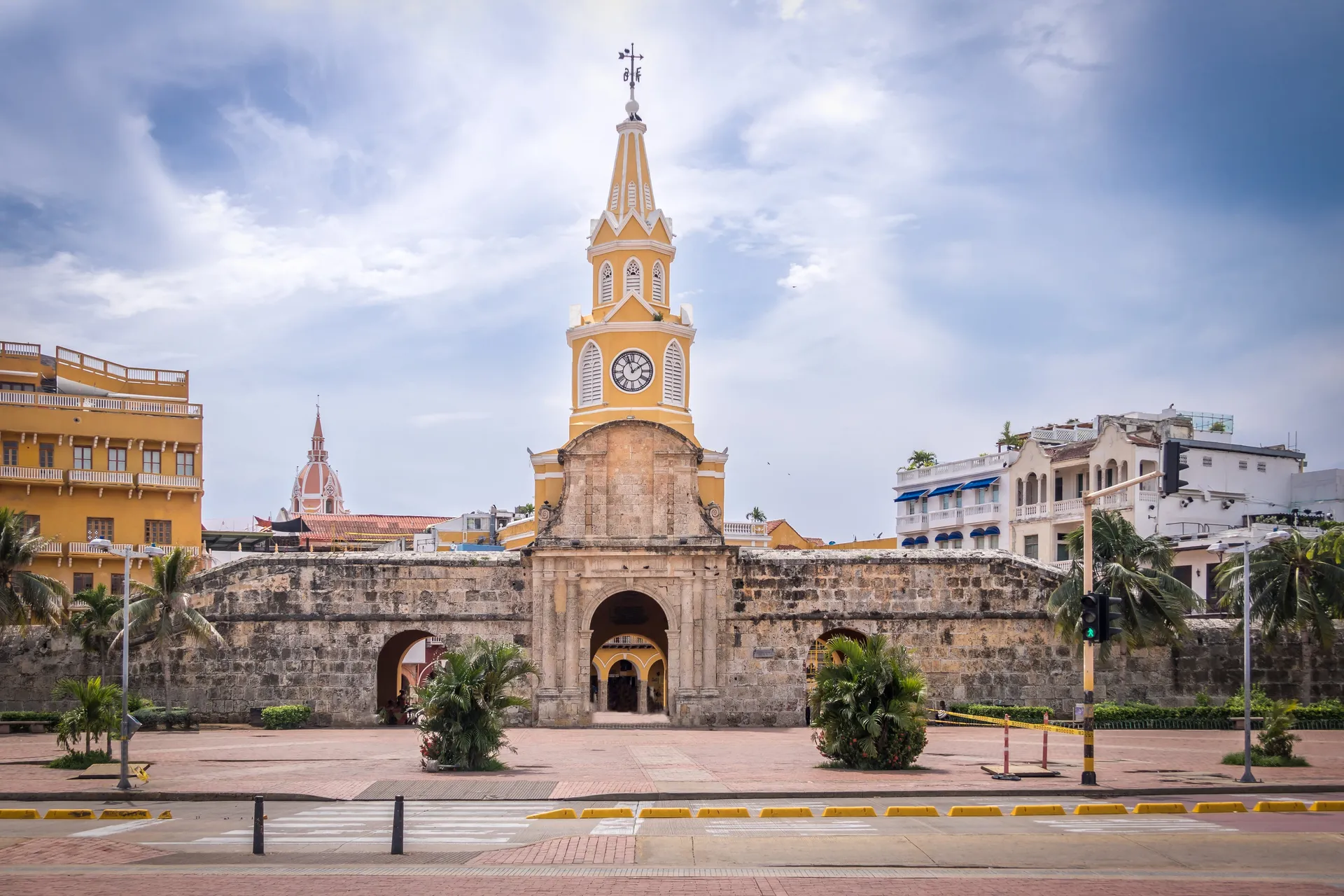
The obvious place to begin is Cartagena, whose walled old city is a UNESCO World Heritage Site and the best-preserved colonial port in the Americas. Founded in 1533, the city grew rich as a hub of Spanish trade and, less proudly, of the transatlantic slave trade, which made it a repeated target for pirates and rival navies. The answer was stone: kilometers of thick ramparts, bastions, and a ring of fortifications that still trace the edge of the old town today.
Walking the walls at dusk, as the heat eases and the light turns the facades gold, is the quintessential Cartagena experience. Within them, the streets open onto plazas of bougainvillea-draped balconies, baroque churches, and the shaded Plaza de Santo Domingo. Just outside the center rises the Castillo San Felipe de Barajas, the largest Spanish fort ever built in the New World, honeycombed with tunnels you can still explore.
Cartagena rewards slow wandering more than a checklist, but a walking tour with a good guide brings the layers of the place to life. For where to base yourself, what to see, and how to move around, our complete Cartagena guide covers the practical detail.
The Colonial Pueblos
Inland, the colonial story continues in a string of small towns that have kept their old bones intact. These are places to slow down, not to tick off.
Villa de Leyva, a three-hour drive north of Bogotá in the department of Boyacá, is the most celebrated. Founded in 1572, it is built around the Plaza Mayor, one of the largest cobbled squares in the Americas, framed by low whitewashed buildings and, on a clear day, the surrounding hills. The town is a national monument, which is why it has escaped modern development so completely. It also makes an easy base for the fossil beds, vineyards, and desert landscapes nearby.
Barichara, in the department of Santander, is often called the most beautiful village in Colombia, and it is hard to argue. Sandstone streets, red-tiled roofs, and honey-colored stone houses climb a hillside above the Suárez River canyon. It sits a short ride from San Gil, Colombia’s adventure-sports capital, which makes it easy to pair quiet heritage days with something more active; see our guide to adventure and adrenaline in Colombia for that side of Santander. The old Camino Real, a restored colonial footpath, links Barichara to the tiny hamlet of Guane on a gentle two-hour walk.
Mompox (also spelled Mompós) is the most atmospheric of the three and the hardest to reach, marooned on an island in the Magdalena River. Once a wealthy river port on the trade route inland from Cartagena, it was left behind when the river shifted course, and the town simply stopped in time. Its languid streets, riverside churches, and workshops of delicate filigree silverwork feel a world away from anywhere. Getting there takes effort, usually a long drive or a combination of bus and boat, but that remoteness is exactly why it has stayed so unspoiled.
San Agustín and Tierradentro
For Colombia’s deep past, head south to two of its greatest archaeological sites, both UNESCO World Heritage Sites and both far older than the Spanish arrival.
The San Agustín Archaeological Park, in the department of Huila, holds the largest group of religious monuments and megalithic sculpture in South America. Hundreds of carved stone figures, some fierce, some serene, guard burial mounds and terraces raised by a culture that flourished here and then vanished, leaving no written record. The centerpieces include the mounds of the main park and the Fuente de Lavapatas, a ceremonial site carved into the bed of a stream. Foreign visitors pay around COP 65,000 (about USD 21) to enter, and the park is closed on Tuesdays, so plan around that. San Agustín town itself is reached by road from Neiva or from Popayán, and it is worth building in a full day or two to see the outlying sites, several of which sit a jeep ride from the center.
Tierradentro, over the mountains in the department of Cauca, is stranger still: a landscape of underground tombs unlike anything else in the Americas. Between roughly 600 and 900 AD, the region’s people carved elaborate shaft-and-chamber tombs, or hypogea, deep into the volcanic rock beneath the hilltops, some large enough to climb down into, their walls painted with red and black geometric designs. The main sites lie along a loop trail near San Andrés de Pisimbalá, with guards on hand to open the tombs for visitors. The park is open from 8am to 4pm, and foreign admission is around COP 65,000 (about USD 21).
Tierradentro is remote, and the roads in from Popayán are rough and slow. This part of Cauca warrants direct, current caution rather than a general note: as of mid-2026, the U.S. State Department maintains a Level 4 “Do Not Travel” advisory for Cauca outside Popayán itself, citing crime and terrorism, and on April 25, 2026, a bombing on the Pan-American Highway in Cajibío, on the corridor between Popayán and the Tierradentro area, killed 20 people and injured dozens more amid a broader wave of attacks across the department that month. Do not treat this guide, or any guidebook, as a substitute for checking your own government’s current travel advisory and the latest local reporting before you plan a route through Cauca. If you do go, a reputable local operator who monitors road conditions day to day is essential, not optional. Our Colombia safety guide covers the general groundwork for planning trips off the main tourist trail.
The Gold Museum and Bogotá
No heritage trail is complete without Bogotá, and its single unmissable stop is the Museo del Oro (Gold Museum), one of the finest museums in Latin America. Its collection of more than thirty thousand pieces of pre-Columbian goldwork is the largest in the world, drawn from the Muisca, Quimbaya, Tairona, Zenú, and other cultures whose metalworking astonished the Spanish and gave rise to the legend of El Dorado. The highlight is the Muisca raft, a small golden votive piece depicting the ceremony on Lake Guatavita that inspired the myth.
The museum sits on Parque Santander in the historic center, an easy walk from La Candelaria, Bogotá’s colonial old town of steep painted streets, the Plaza de Bolívar, and the Botero Museum. The Gold Museum is open Tuesday through Saturday from 9am to 6pm and Sunday from 10am to 4pm, and it is closed on Mondays. Adult admission is COP 5,000 (about USD 1.60), and entry is free on Sundays, though expect it to be busiest then. For everything else the capital offers, our Bogotá guide is the place to start.
Building a History-Focused Route
You can join these threads into one trip, though the sites are spread across the country, so choose according to your time.
- A long weekend: base in Bogotá, spend a day in La Candelaria and the Gold Museum, then take an overnight or two in Villa de Leyva, an easy drive north.
- About a week: add the Santander leg, pairing Barichara and the Camino Real with the adventure hub of San Gil, before or after your Bogotá and Boyacá days.
- The full arc: combine the colonial coast and the ancient south. Start in Cartagena, then fly to the interior for Bogotá and the Boyacá pueblos, and finish with the long southern loop through San Agustín and, conditions permitting, Tierradentro.
The archaeological south rewards travelers who go slowly and travel by day, ideally with a guide who knows the roads. Wherever your interest lies, from Caribbean ramparts to painted tombs, Colombia’s past is close to the surface and refreshingly free of crowds.