
Updated
On this page
Colombia is home to more than eighty indigenous peoples, many of whom still live on the land their ancestors have held for centuries and continue to govern it under their own authorities and law. For a visitor, spending time with one of these communities can be among the most memorable parts of a trip. It is also the part most easily done badly. The difference comes down to a single idea: you are a guest on someone else’s territory, and the terms of your visit are theirs to set, not yours.
That is why this guide is built around community-led visits. The experiences worth seeking out are the ones a community has chosen to open, runs on its own terms, and profits from directly. They are not tours where an outside agency arranges access to people who had little say in the matter. Colombia’s indigenous nations are living, self-governing peoples with their own priorities, and tourism is something many of them are shaping deliberately, welcoming outsiders into some spaces while keeping others closed. Going respectfully means booking through the communities themselves or organizations they genuinely control, arriving with patience, and treating the whole thing as a conversation rather than a sightseeing stop.
This page complements the shorter overview on our experiences hub, going deeper into three regions where community-run visits are established: the Sierra Nevada de Santa Marta, the desert of La Guajira, and the Amazon around Leticia.
The Sierra Nevada de Santa Marta
The Sierra Nevada de Santa Marta rises from the Caribbean coast to snow-capped peaks, and its slopes are home to four indigenous peoples: the Arhuaco, Kogi, Wiwa, and Kankuamo. They understand the massif as the origin and center of the world, a place whose balance they are responsible for keeping, and they mark its sacred boundary with an invisible perimeter of connected sites known as the Línea Negra, the Black Line. Much of what happens in the Sierra, from where outsiders may walk to what may be photographed, is governed by that worldview.
It helps to be clear about what a visit here is and is not. It is not a chance to wander into a village and observe daily life. The Arhuaco spiritual capital of Nabusimake, reached through the town of Pueblo Bello, is closed to casual visitors, and access depends entirely on permission from community authorities that is not granted as a matter of course. The Kogi, in particular, keep much of their territory and ceremony private by choice. What is genuinely open are structured experiences that communities have designed, usually shorter walks to a settlement or interpretive center where hosts share what they wish to share, alongside the multi-day treks toward the terraced ruins of the Ciudad Perdida (Lost City) that pass through indigenous land under agreed rules.
The clearest example of community control is Wiwa Tour, a travel agency created in 2008 together with Wiwa traditional authorities to bring ecotourism in the Sierra under indigenous management. Its staff is overwhelmingly indigenous, with roughly thirty Wiwa and Kogi guides leading treks and its Gotsezhy community-tourism program, so that the income and the decisions stay inside the community. If you are drawn to the Sierra mainly for the walking, our guide to trekking and hiking in Colombia covers the Lost City route in more detail; the point here is to choose an operator the communities actually run.
The Wayuu of La Guajira
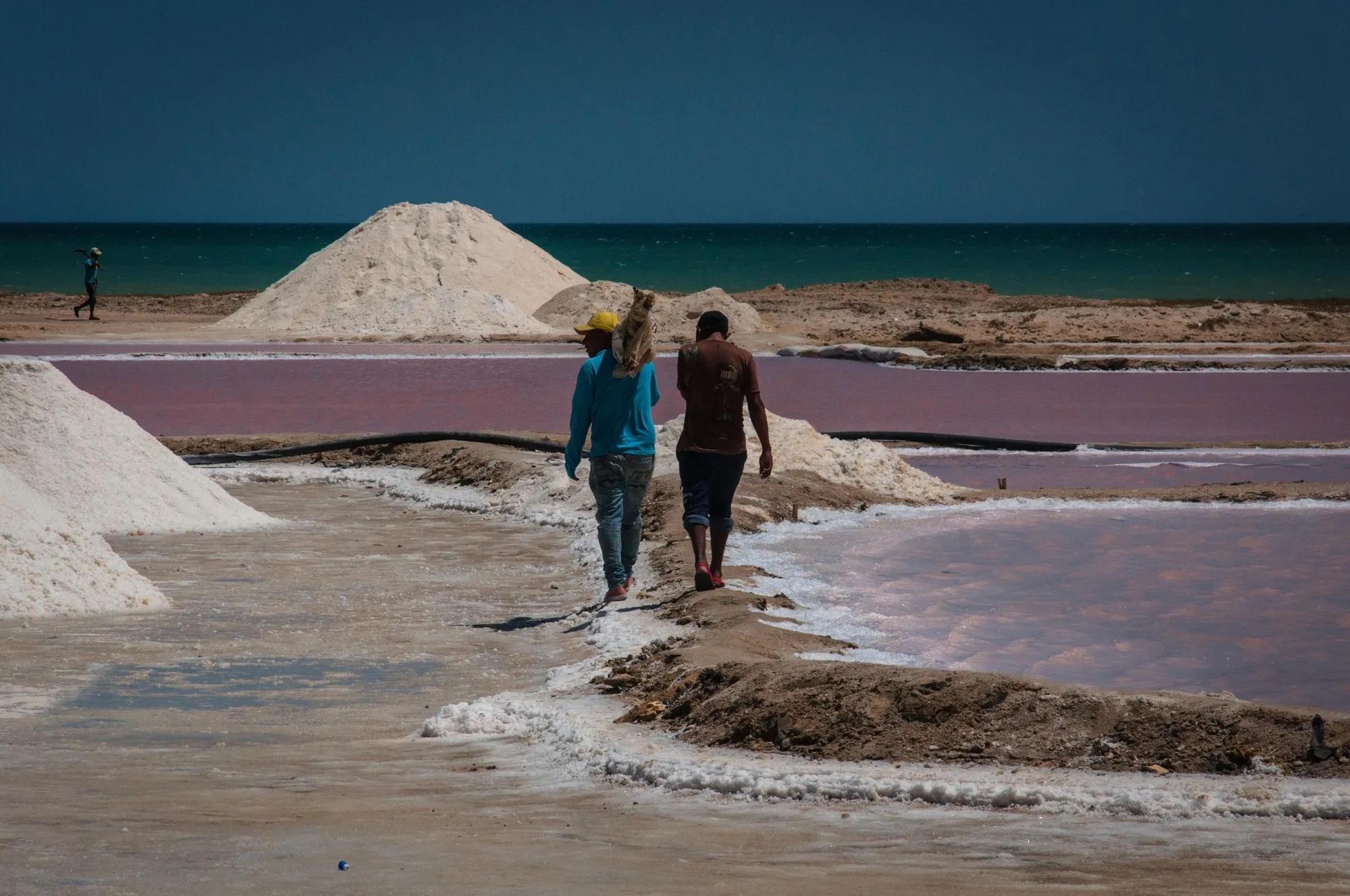
At Colombia’s northern tip, the desert peninsula of La Guajira is the homeland of the Wayuu, the country’s largest indigenous group and one that never fully submitted to Spanish rule. They keep their own language, wayuunaiki, a clan-based social structure reckoned through the mother’s line, and a body of customary law recognized by UNESCO. Wayuu families live dispersed across the scrubland in settlements called rancherías, and it is these that form the basis of tourism here.
A ranchería visit or overnight stay, when arranged with a Wayuu host rather than around them, offers a window into desert life: how families draw water where there is almost none, herd goats, and pass down the myths and weaving traditions that anchor their identity. The mochila bags you see all over Colombia are woven here, each pattern carrying meaning, and buying directly from the women who make them keeps the value in the community. Our guide to artisanal crafts goes further into Wayuu weaving and where it fits among the country’s craft traditions.
Verifying who actually runs a given ranchería experience takes a little care, because many trips into La Guajira are sold by agencies in Riohacha with varying degrees of genuine Wayuu involvement. The responsible approach is to ask directly who owns and staffs the ranchería you would stay at, whether your hosts are Wayuu, and how much of what you pay reaches them. Increasingly, young Wayuu are trained as community guides and run their own rustic lodges, and a good operator will connect you with them rather than substitute for them. If a booking cannot tell you clearly whose land you are visiting and on what terms, treat that as a reason to keep looking.
Amazon Communities Near Leticia
In Colombia’s southern corner, the river town of Leticia is the gateway to a stretch of Amazon shared with Peru and Brazil. The banks of the river here are dotted with indigenous communities, mostly Ticuna along with Cocama, Yagua, and Uitoto people, all self-governing and increasingly organized around tourism they manage themselves. The knowledge they share is intensely practical: which plants heal, how the forest is read, how to move on the water. For the wider natural setting, from pink river dolphins to jungle lodges, see our guide to nature and wildlife.
The most rewarding base for community-run visits is the small town of Puerto Nariño, upriver from Leticia, whose residents are largely Ticuna and where most businesses are locally owned, so money spent stays close. From there, the Ticuna community of Mocagua sits at the edge of Amacayacú National Park and has become a model of community stewardship: having agreed to stop hunting endangered species, its residents now protect the forest and its woolly monkeys, working with the community-partnered Maikuchiga Foundation, and welcome visitors for guided forest walks led by community members. Other Ticuna settlements along the river open their doors for cultural exchanges centered on language, crafts, and daily work.
As in La Guajira, the guiding question is who benefits. Prioritize communities and locally owned guesthouses over agencies that treat a village as one stop on a packaged circuit, and let your hosts set the pace and the boundaries of what is shown.
How to Book Responsibly
The through-line across all three regions is the same. Aim for experiences that a community owns, staffs, and profits from, and be willing to ask direct questions before you commit.
- Book with the community or an organization it controls. The clearest cases, like Wiwa Tour in the Sierra Nevada or locally run guesthouses around Puerto Nariño, are indigenous-owned by design. When an operator is not, ask who owns it and how many of its guides are from the community.
- Ask where the money goes. A genuine community operator can tell you plainly how much of your payment reaches local families. Vagueness is a signal to look elsewhere.
- Let the community set the terms. Some places, ceremonies, and sites are closed, and that is not a gap in the itinerary to be negotiated. Respect a “no” as readily as a “yes.”
- Do not expect to show up. Meaningful visits are arranged in advance, sometimes well in advance, and a few of the most sacred sites are not open at all. Plan around that rather than against it.
- Learn a few words. A handful of Colombian Spanish phrases helps, and an effort to learn even a greeting in the local language goes further still.
Etiquette and Expectations
Once you are there, a little humility does most of the work. These are guidelines that hold across communities, though your hosts’ own instructions always take precedence.
- Always ask before photographing people, and accept a refusal without pressing. Many communities restrict or forbid photography of ceremonies and sacred objects entirely.
- Dress modestly and follow your hosts’ lead on where you may walk and what you may touch or enter.
- Buy directly from makers. Purchasing a mochila, a carving, or a woven piece from the person who made it is one of the most direct ways your visit helps.
- Follow local rules on offerings and sacred sites. In the Sierra Nevada especially, particular places carry spiritual weight, and outsiders are expected to stay out unless explicitly invited.
- Come to listen. The value of these visits lies in perspective, not in a checklist of things seen. Slow down, ask questions, and let the exchange be unhurried.
- Mind the practicalities. These regions are remote, connectivity is thin, and plans shift with weather and river levels. Build in flexibility, and review our Colombia safety guidelines for the basics of traveling in rural areas.
Approached this way, time with an indigenous community is not a transaction or a spectacle but a genuine meeting between people, on terms your hosts have chosen. That is what makes it worth doing, and worth doing carefully.