
Updated
On this page
Colombia’s geography is built for adrenaline. Three branches of the Andes throw up canyons, cliffs, and legendary climbs; fast rivers tumble off the mountains toward two coastlines; and warm Caribbean reefs sit a short flight from the interior. Put it together and you have one of South America’s great playgrounds for active travelers, with the country’s scenery doing half the work on every trip.
The activities cluster in a handful of places that have built real expertise around them. San Gil, in the department of Santander, is the unofficial adventure capital, packing rafting, caving, and rappelling into one small town. The vast Chicamocha Canyon nearby draws paragliders, the sandstone cliffs of Suesca pull climbers out of Bogotá, and the reefs off San Andrés and the Caribbean coast reward divers. Colombia’s steep mountain roads, meanwhile, are a pilgrimage for cyclists chasing the climbs that produced a generation of Grand Tour champions.
This guide walks through the country’s headline adventure sports, what each one costs, and how to book it sensibly. Prices below were current at the time of writing and are worth reconfirming with operators, as they shift with season, group size, and what a package includes.
San Gil: The Adventure Capital
Set on the Río Fonce in Santander, San Gil is a compact town that runs almost entirely on adrenaline. It is walkable, cheap, and lined with operators, which makes it the easiest base in the country to string several activities together over a couple of days.
Whitewater rafting is the signature. Two rivers frame the choice. The Río Fonce, running right through town, offers gentler Class II and III water that suits first-timers and families, on trips of roughly an hour and a half. The Río Suárez, half an hour away, is a serious step up: sustained Class IV and V rapids that rank among the most challenging commercially run whitewater in South America, for confident swimmers with some experience. A Suárez trip typically runs COP 150,000 to COP 250,000 (about USD 47 to 79) per person, usually including transport, equipment, a guide, and photos.
San Gil is also honeycombed with caves. The best known are the Cueva del Indio and the Cueva de la Vaca, where guided trips wade, crawl, and swim through underground passages by torchlight for about two hours. Entry to a cave generally costs around COP 30,000 (about USD 9) per person, with transport arranged separately or bundled into a combined day tour.
Rounding out the town’s roster is waterfall rappelling, most often at the Cascadas de Juan Curí, where you descend alongside the falling water on a guided abseil. It pairs naturally with a swim in the pools below, and operators run it as a half-day outing. As with everything in San Gil, book through an established agency, confirm exactly what is included, and check that guides provide and fit proper safety equipment before you set off.
Paragliding Chicamocha
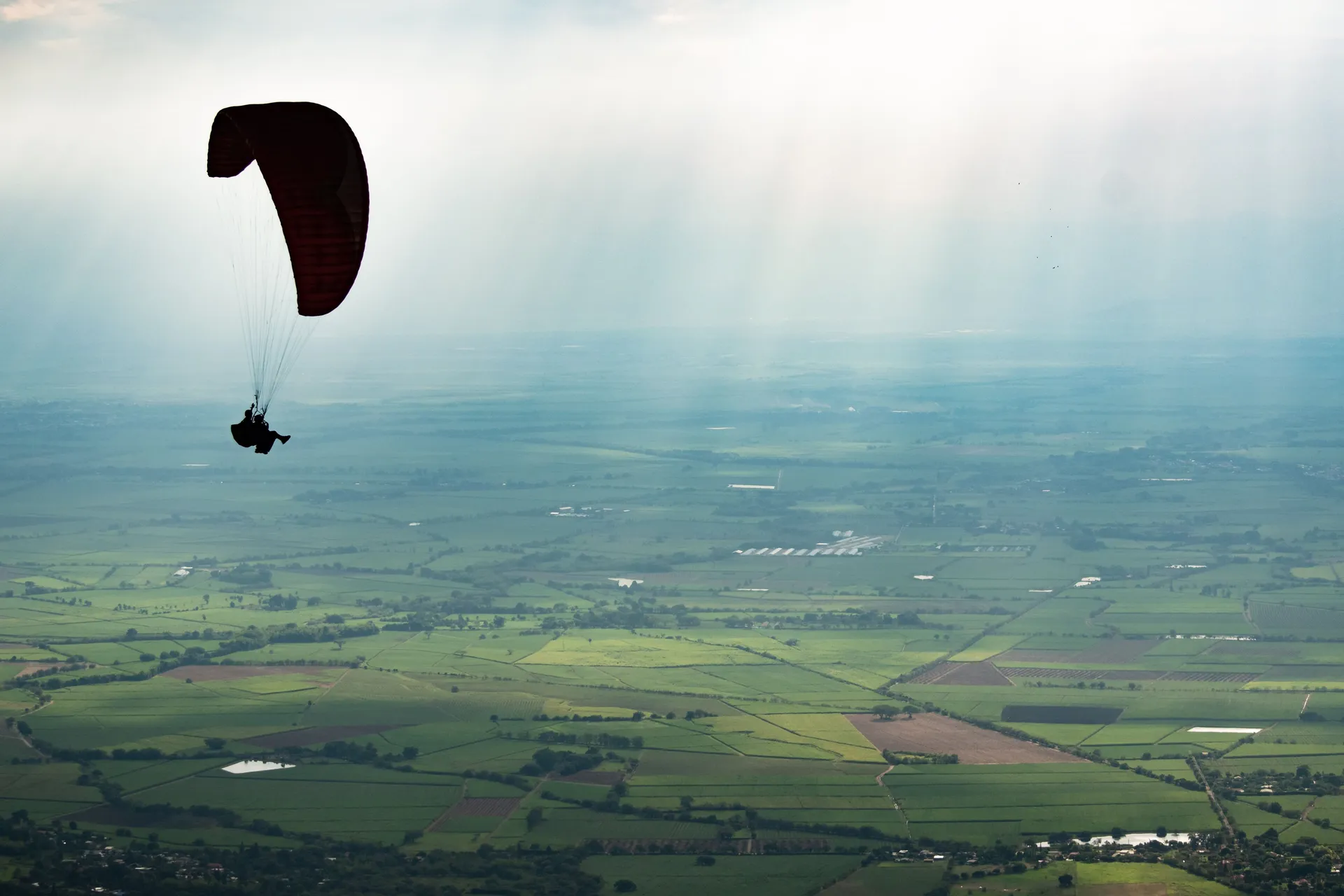
An hour or so from San Gil, the land falls away into the Chicamocha Canyon, one of the largest canyons in the world and the backdrop for some of Colombia’s best flying. Tandem paragliding here means launching with a certified pilot and soaring on thermals over a landscape of arid ridges and the green thread of the Río Chicamocha far below, no experience required.
Most tandem flights last around 20 minutes in the air and cost roughly COP 200,000 to COP 250,000 (about USD 63 to 79) per person, with transport from San Gil or Barichara sometimes included and sometimes charged on top. Video and photos of your flight are usually an optional extra, often around COP 50,000 (about USD 16). Flights depend on the wind, so build in some flexibility and expect your pilot to reschedule rather than launch in poor conditions. Confirm that the operator’s pilots are licensed and that the flight includes insurance before you commit.
Rock Climbing at Suesca
The sandstone cliffs at Suesca, about an hour and a half north of Bogotá, are the spiritual home of Colombian rock climbing. A long line of orange rock rises above the railway and the Río Bogotá, offering hundreds of routes across every grade, from beginner-friendly slabs to hard multi-pitch lines, which is why generations of the country’s climbers learned here.
You do not need to arrive with skills or gear. Local guides at the base of the cliffs run short introductory climbs for as little as COP 15,000 (about USD 5) for a couple of routes, equipment included, which is one of the cheapest ways to try the sport anywhere. Full-day guided experiences booked out of Bogotá, with hotel pickup, instruction, and a professional guide for the day, run considerably more, often around USD 99 to 110 per person. Whichever you choose, make sure your guide is experienced and provides a helmet, harness, and rope, and that top-rope anchors are set by someone who knows the crag.
Suesca works as an easy day trip or overnight from the capital, and it pairs well with the highland scenery around the town. It is a natural add-on for anyone already tackling the treks in our guide to trekking and hiking in Colombia.
Diving and Snorkeling
Colombia’s Caribbean gives divers warm water, healthy reefs, and some of the most affordable certification in the Americas.
The clearest water is out in the archipelago of San Andrés and Providencia, where the surrounding sea is so vivid that locals call it the sea of seven colors. San Andrés has a cluster of well-established dive shops running two-tank boat dives for certified divers and introductory “discover scuba” dives for beginners. Prices vary by operator, by what is included, and by season, and several shops quote in US dollars, so compare current quotes directly and choose a center with strong safety credentials rather than the lowest headline price. Providencia, a short flight or catamaran onward, is quieter and sits beside the Old Providence barrier reef, which Colombia’s submission to UNESCO describes as one of the largest barrier reefs in the Caribbean. The islands feature in our full guide to Colombia’s beaches and islands.
On the mainland, the fishing village of Taganga, next to Santa Marta, is famous as one of the cheapest places in South America to learn to dive, with several PADI centers running multi-day open-water certification courses and small-group fun dives in the waters around Tayrona National Park. Course and dive prices vary by operator and season, so request a current quote directly, and choose a center with strong safety credentials rather than the lowest headline price. Taganga makes an easy add-on to a Santa Marta stay; see our roundup of things to do in Santa Marta for the wider area. Snorkelers, meanwhile, are well served everywhere the divers go, from the Rosario Islands off Cartagena to the shallow reefs of San Andrés.
Cycling the Andes
Colombia is cycling-mad, and riders like Nairo Quintana and Egan Bernal turned the country’s punishing mountain roads into bucket-list terrain for visiting cyclists. The climbs are the draw. The most storied is the Alto de Letras, widely cited as one of the longest paved ascents on earth: roughly 80 kilometers of near-continuous climbing that gains some 3,700 meters from the Magdalena valley up into the central Andes. Shorter but no less scenic routes thread through the coffee country and the mountains around Medellín, where weekend group rides are a local institution.
You do not need to bring your own bike. Specialist operators in Medellín and Bogotá rent quality road bikes and run guided tours ranging from single-day outings to multi-week traverses, usually with a support vehicle, mechanic, and bilingual guide. Rental is often tied to booking a guided tour rather than offered standalone, so confirm the arrangement when you enquire, and pin down what the day rate or package covers, including support, meals, and transfers. For riders who would rather leave the logistics to someone else entirely, a guided Colombia tour can fold cycling days into a wider itinerary.
Booking and Practicalities
Adventure sports reward a little homework. A few principles apply across all of them:
- Book with reputable, established operators. Look for agencies with a track record, current certifications, and equipment that is well maintained and correctly fitted. For flying and diving especially, confirm that pilots and instructors are licensed and that your booking includes proper insurance cover. The cheapest quote is rarely the one to chase.
- Buy travel insurance that covers adventure activities. Many standard travel policies exclude rafting, paragliding, diving, and climbing, or cap the altitude or “hazardous activity” they will pay out on. Read the fine print before you travel and buy a policy that explicitly covers what you plan to do, including any medical evacuation.
- Reconfirm prices and conditions. The figures in this guide were accurate at the time of writing but move with the season, the exchange rate, and what a given package bundles in. Ask exactly what is and is not included, and carry cash, as many smaller operators do not take cards.
- Build in flexibility. Wind, water levels, and weather can push a paragliding flight or a river run to another day. Give each activity room in your schedule rather than booking it for the morning of your flight home.
- Follow your guide. Listen to the safety briefing, wear the gear as fitted, and be honest about your fitness and experience so operators can put you on the right river, route, or dive.
For the wider picture of what a Colombia trip can hold, from coasts to high mountains, browse our full roundup of unforgettable Colombian experiences.