
Season report, July 24, 2026. For trip planning, use the maintained whale watching guide. Prices and advisory details below reflect the original reporting date.
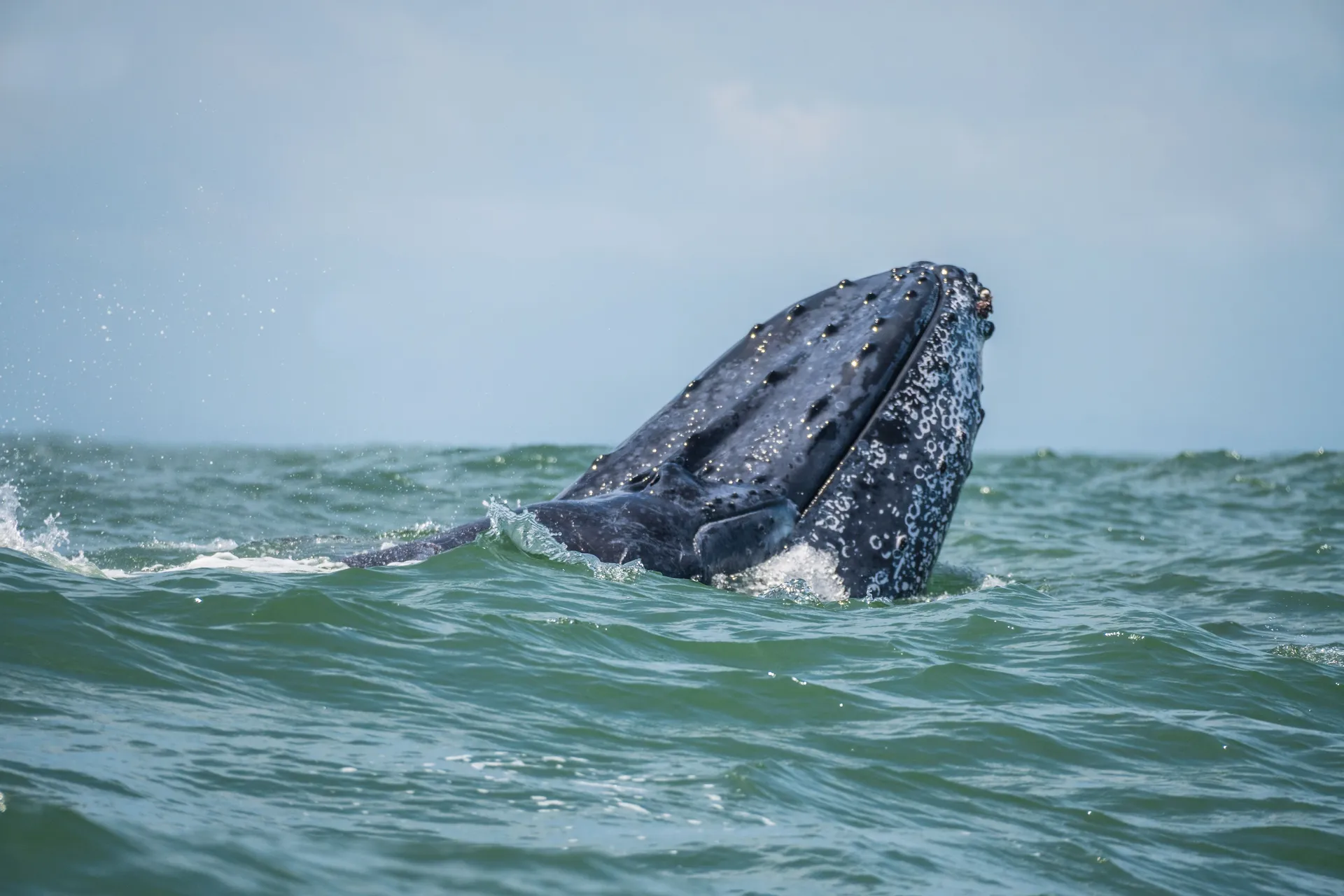
Every year between roughly July and October, humpback whales that have spent the southern summer feeding in Antarctic waters turn north and swim several thousand kilometers to the warm shallows of Colombia’s Pacific coast. They come to mate and to calve, and they stay for months. Colombian authorities expect thousands of them this season, with widely reported estimates in the range of 6,000 to 8,000 animals. The season is underway now, and the best weeks are still ahead.
This is one of the genuinely great wildlife spectacles in the Americas, and it is also one of the more complicated Colombian trips to plan, for reasons that have nothing to do with the whales. Here is what is happening, how people go, and what the current travel advice says.
Why the Colombian Pacific
Humpbacks that feed off Antarctica and southern Chile follow one of the longest migrations of any mammal, arriving in Colombian waters to breed. The bays and inlets along the Pacific coast are warm, sheltered, and relatively shallow, which makes them good places to give birth and to raise a calf through its first months. That is why sightings here are often close to shore and often involve mothers with calves, rather than distant fins on the horizon.
The Colombian government treats the season as a formal event. In late June 2026 the environment ministry, the tourism ministry, the maritime authority, and the national parks service issued joint guidance for the season, aimed at keeping boats from harassing the animals during the months they are most vulnerable.
Responsible Watching Guidance
The 2026 guidance is specific, and it is worth knowing before you book, because an operator who ignores it is telling you something about how they work. The June 26, 2026 joint circular and MinAmbiente’s separate good-practice advice recommend the following. The circular is advisory and does not replace requirements imposed by local authorities:
- Boats keep a minimum distance of 200 meters from whales.
- No more than three vessels may watch the same whale or group at once.
- A single boat may observe for up to 30 minutes. If more than one boat is present, the limit drops to 15 minutes.
- Approaches are made at a 45 degree angle toward the rear half of the animal, never head-on and never from directly behind.
- Vessels move at low, constant speed, and leave at under 10 kilometers per hour, about five knots.
- Each boat may make a maximum of two trips a day, one morning and one afternoon, in good natural light, with at least three hours between them.
- Boats must be properly registered and hold a valid navigation license from the maritime authority.
A good operator will volunteer most of this before you ask. If a boat is racing another one toward a blow, or crowding a mother and calf, that is not an unlucky day, it runs counter to responsible watching guidance.
Where People Watch Them
The whales range along the whole Pacific coast, but the practical bases fall into two very different groups, and the travel advice for them is not the same.
Nuquí and Bahía Solano, in Chocó, are the best known. Both are small coastal towns with no road connection to the rest of the country, backed by rainforest, with a cluster of small eco-lodges, many of them run by Afro-Colombian and Emberá communities. You reach them by air. Satena flies to both from Medellín’s Olaya Herrera airport and connects through Quibdó, with one-way fares on its own route pages starting around COP 149,900 (about USD 47) to Nuquí, and higher on some routes and dates.
The Valle del Cauca and Cauca coast, including Bahía Málaga, Juanchaco, Ladrilleros, and Gorgona island, is the other traditional watching area, usually reached by boat from Buenaventura. As things stand, this is where the travel advice gets more restrictive, and the callout below explains why.
What a Trip Costs
Whale watching here is rarely a standalone boat ticket. Because the lodges are remote and small, most visits are sold as multi-night packages covering transfers, room, all meals, and daily outings. For the 2026 season, packaged trips to Nuquí from Colombian operators have been advertised at around COP 2,450,000 (roughly USD 775) per person for a stay of several nights, with deposits of a few hundred thousand pesos to hold a place. Prices vary widely with the lodge, the season, and how many nights you take.
Add flights on top, budget cash for the trip, and expect limited card acceptance and patchy connectivity once you arrive. Our cost of traveling in Colombia breakdown puts that in context against the rest of the country, and our notes on staying connected cover what to expect from coverage before you go somewhere this remote. This is not a place where you improvise a booking on arrival, especially in August and September.
What the Travel Advice Says
Check the advisories before you plan this trip, because they treat different parts of the coast differently.
The UK Foreign, Commonwealth and Development Office advises against all but essential travel to Chocó Department, “except for the department capital Quibdó, the whale-watching towns of Nuquí and Bahía Solano and the tourist site of Capurganá.” It adds a specific condition for those towns: “If you intend to travel to the whale-watching towns of Bahia Solano and Nuqui, only do so by air and do not travel inland or along the coast out of town.”
Canada’s advisory, updated July 9, 2026, takes the same shape. It places Chocó under “avoid all travel” but lists Bahía Solano, Capurganá, and Nuquí as exceptions, where it advises avoiding non-essential travel instead.
The Valle del Cauca coast is treated differently. The FCDO advises against all but essential travel to the western part of Valle del Cauca Department, including Buenaventura, and to the western part of Cauca Department, and it lists no equivalent exception for Juanchaco, Ladrilleros, Bahía Málaga, or Gorgona.
Advisories change. Check the FCDO Colombia advice and your own government’s current guidance close to your travel dates, and read our Colombia safety guidelines alongside them.
The named exceptions do not extend automatically to every nearby coastal lodge or excursion. The UK wording restricts travel out of town, and Canada’s exception still carries advice to avoid non-essential travel.
When to Go
The season runs from around July into October, and official guidance for the season covers July through November. August and September are the peak, when mothers with calves are most reliably seen close to shore, and they are also when the lodges fill. Book well ahead for those two months.
Two other things worth setting expectations on. This is one of the wettest inhabited places on earth, so rain is part of the trip in any month, and the light can be flat and gray. And these are wild animals, not a scheduled show. Most people who go out in peak weeks see whales, often at very close range, but nobody can promise you a breach.
If you are still shaping the wider trip, our guide to the best time to visit Colombia covers how the Pacific season fits with the rest of the country’s weather, and our nature and wildlife page covers what else is worth building a trip around.
Sources checked July 24, 2026.
Clarification, September 19, 2026: the national circular provides guidance rather than replacing local rules. The advisory summary has also been clarified: a named-town exception does not cover every coastal itinerary. The report otherwise retains its July publication context.
Sources
- MinAmbiente: government guidelines for responsible whale watching in the Colombian Pacific (joint circular, June 26, 2026)
- MinAmbiente: good practices for responsible whale watching in Colombia
- UK FCDO: Colombia regional risks
- Government of Canada: Colombia travel advice
- Satena: flights from Medellín to Nuquí
- Satena: flights to Bahía Solano
- Semana: planning a responsible whale watching trip to Nuquí or Bahía Solano, 2026
- Vanguardia: more than eight thousand humpbacks expected in the Colombian Pacific in 2026