
Every country’s slang is a map of what its people care about, and Colombian Spanish is unusually easy to read that way. The words that come up dozens of times a day, in a shop, at a bus stop, or over a coffee, are a running commentary on how Colombians treat each other, how they think about time, how they make a living, and how they have a good time.
This is not a phrasebook. Our page of Spanish phrases for Colombia has the practical words, including parce, chévere, and qué pena, laid out to be used. This is about what a handful of everyday expressions tell you about the country, which makes them easier to understand when you hear them, and easier to use well.
Politeness Is Built Into the Grammar
The first thing many visitors notice is how much courtesy Colombians fit into a simple transaction, and the language carries a lot of it.
¿Me regala…? Walk into a café and you will hear people order with ¿me regala un tinto?, literally “will you gift me a coffee?” Nobody is asking for anything free. It is a way of turning a purchase into something closer to asking a favor, and you pay as usual. Visitors who learn ¿me regala…? instead of the blunter quiero (“I want”) sound noticeably more at home.
Usted, almost everywhere. In much of the Spanish-speaking world, tú is the friendly form of “you” and usted is the formal one. In Colombia, particularly in Bogotá and the highlands, usted is used far more widely, including between friends, between partners, and with children. That is not coldness. Here usted carries warmth and respect at the same time, and using it with strangers, as a visitor, is never wrong.
Sumercé. In Bogotá and the surrounding highlands of Boyacá and Cundinamarca, you may be called sumercé, a contraction of the old su merced, “your mercy.” The Diccionario de americanismos describes it as a form of address expressing affection or respect, rooted in rural speech and now heard far more widely. If a market vendor in Bogotá calls you sumercé, take it as the kindness it is.
Diminutives everywhere. Colombians soften almost anything with a diminutive: un momentico (just a little moment), un tintico, cerquita (very close by). Listen for the -ico ending in words like momentico, where many other Spanish speakers would say momentito. Diminutives make requests gentler and moments shorter, at least in theory.
What these share is a preference for keeping things pleasant. Directness is not a virtue in casual Colombian interactions the way it can be in English, and the language gives people many ways to ask, decline, or disagree without anyone losing face. For a visitor, that means two things: a greeting before a question goes a long way, and a soft “maybe” can be a polite “no.”
Time Is Elastic
Ahorita is the word that most confuses visitors, and with good reason. It is a diminutive of ahora, “now,” so you would expect it to mean “right now.” The Diccionario de americanismos records two Colombian senses: “in a moment, later,” and “a little while ago.” Neither is “now.”
So when someone tells you the bus leaves ahorita, or the owner will be back ahorita, the honest translation is “at some point soon, probably.” Plans, appointments, and timetables in Colombia have more give in them than many visitors are used to, especially outside business settings. The practical answer is to ask for a time: ¿a qué hora, más o menos? A clock time gets you a commitment that ahorita never will.
The give is mostly in the personal and the informal: a friend’s “I’m on my way,” a shop that will open ahorita, a lunch that starts when everyone arrives. Do not apply it to a flight.
Making a Living: El Rebusque
If you learn one word to understand the street economy, make it rebusque. The Diccionario de americanismos defines it, in Colombia and several other countries, as the occasional work or set of tasks that brings in enough to get by, and also as an ingenious, improvised fix to a problem.
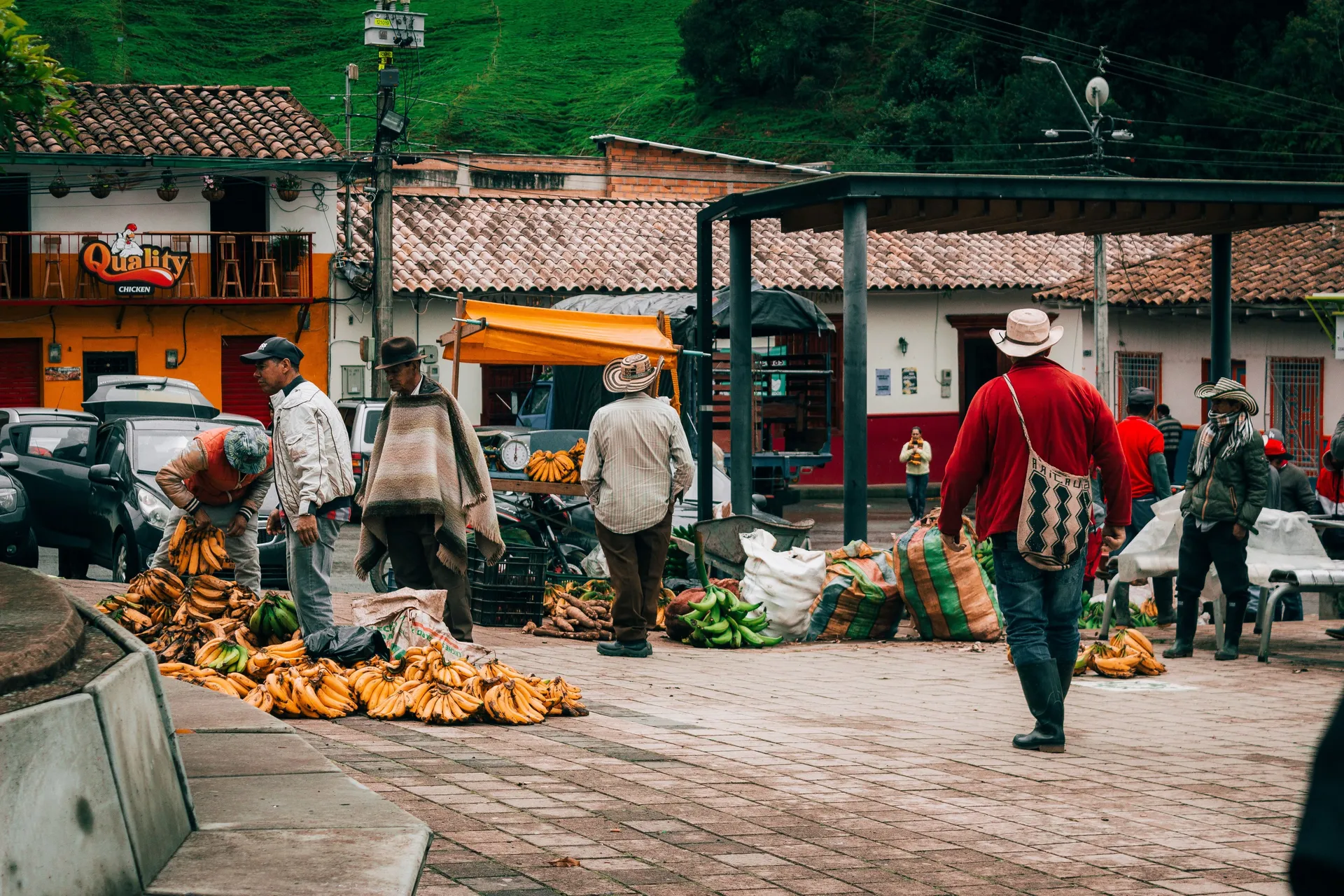
You see el rebusque everywhere: the man selling bags of cut mango at a traffic light, the woman with a thermos selling tintos from a cart at a bus station, the person who will watch your car, fix your phone screen in ten minutes, or sell you a single cigarette or a phone minute. It exists on this scale because so much of Colombian work is informal. According to DANE, the national statistics agency, more than half of working people in Colombia are in informal employment, and in rural areas the share is far higher.
Two other words sit beside it. A job is a camello, literally a camel, the beast that carries the load, and to work is camellar. And the person who works hard and does not give up is berraco, which is among the highest compliments the language has.
For a visitor, knowing this changes how the street reads. The vendors working the bus, the beach, or the plaza are not a nuisance laid on for tourists. They are doing el rebusque, as millions of Colombians do. A polite no, gracias is perfectly fine. So is buying the mango.
Friendship and Where You Are From
Colombian Spanish is strongly regional, and the words people use for each other tell you where you are.
In Medellín and the Paisa region, friends are parce or parcero, and people commonly use vos rather than tú for “you,” with its own verb forms (¿vos qué querés?). In Cali you will hear vos too, along with ve dropped into sentences for emphasis. On the Caribbean coast, the rhythm changes completely: speech is faster, consonants drop away, and expressions like ajá and eche punctuate conversation in a way that sounds nothing like Bogotá.
None of this is something a visitor needs to imitate. But knowing that the differences are real helps explain why Colombians are so attached to their regional identity, and why a person from Medellín, a Caleño, and a Costeño will each tell you, with some pride, that they are nothing like the others.
The Good Times, and the Morning After
Colombians have a rich vocabulary for going out. A party or a night out is a rumba. Your group of friends, or the plan for the evening, is your parche. And the morning after has its own word, guayabo, which the Diccionario de americanismos defines as the discomfort of waking up after drinking too much.
The same dictionary records a second Colombian sense of guayabo: the sadness of missing someone or something. It is hard to think of a better example of how a language bundles experience. The word for a hangover is also the word for heartache, and anyone who has spent the morning after a long rumba thinking about someone will understand why.
Why It Is Worth Knowing
You do not need any of this vocabulary to travel in Colombia, and as our post on whether you need Spanish argues, the basic phrases matter far more than slang. But a few of these words do practical work. ¿Me regala…? makes you sound polite. Asking for a time instead of accepting ahorita saves you an afternoon of waiting. And understanding el rebusque turns a street that seems full of people selling things into a picture of how most of the country makes a living.
Mostly, though, they are worth knowing because they are a pleasure. Colombians enjoy their language, and noticing what it says is one of the easiest ways to start understanding the country.
Sources
- Diccionario de americanismos (ASALE): ahorita
- Diccionario de americanismos (ASALE): rebusque
- Diccionario de americanismos (ASALE): sumercé
- Diccionario de americanismos (ASALE): guayabo
- Diccionario de americanismos (ASALE): camello
- DANE: informal employment and social security statistics
Frequently Asked Questions
Why do Colombians say 'me regala' when buying something?
It is a courtesy, not a request for something free. ¿Me regala un tinto? literally means 'will you gift me a coffee?' but works as 'could I have a coffee, please?', and you pay as normal. It softens a request into something closer to asking a favor, which fits how much weight everyday politeness carries in Colombia.
What does 'ahorita' mean in Colombia?
It depends on the moment. The Diccionario de americanismos records it in Colombia both as 'in a little while, later' and as 'a little while ago'. In practice, ahorita is elastic, and it rarely means 'right now'. If timing matters, ask for a time.
What does 'guayabo' mean in Colombia?
A hangover. Colombians also use it for the sadness of missing someone or something, which tells you something about how closely the two are associated.
What is 'el rebusque' in Colombia?
Getting by through whatever work you can find: occasional jobs, selling on the street, and ingenious fixes to make ends meet. The word matters because so many Colombians do it. More than half of working people in Colombia are in informal employment, according to DANE, the national statistics agency.