
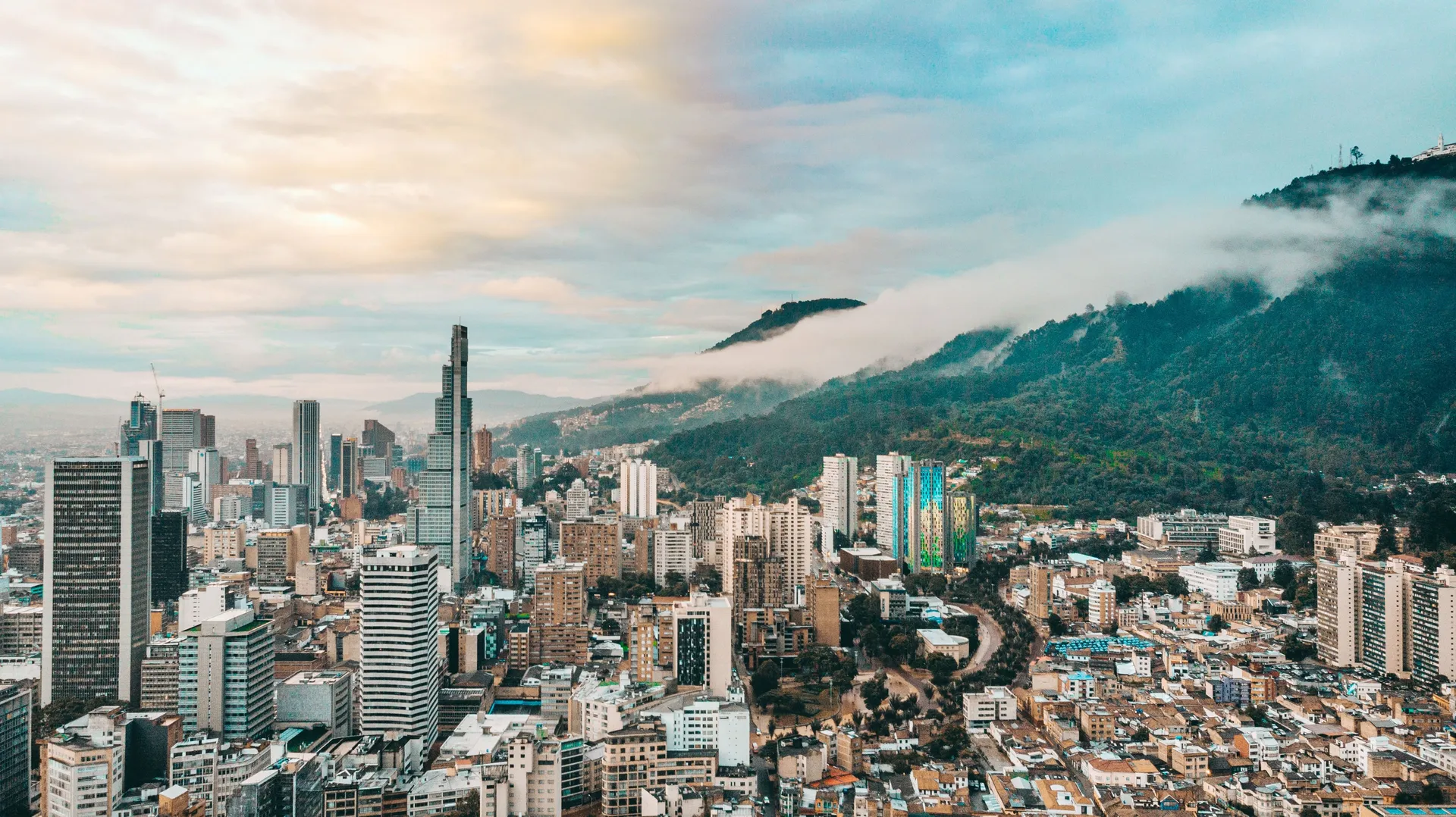
Few countries carry as much secondhand baggage as Colombia. Say you are going and someone will picture a Netflix title card, a jungle, or a headline from decades ago. Some of that comes from a real and painful history, and some of it is just stale trivia repeated until it hardened into fact. Either way, it tends to describe a country that no longer exists, or that never quite existed in the first place. Here are the myths that come up most often, and what the place is actually like once you look past them. We have kept the numbers current and sourced them at the bottom, because a myth is best answered with something you can check.
Colombia Is Stuck in the Narcos Era
This is the big one, the frame almost every other assumption hangs on. A generation grew up on films and streaming series set during the cartel violence of the 1980s and 1990s, and for many travelers that dramatized decade is still the whole picture. It is not. Colombia today is a country that welcomed a record 6.7 million foreign visitors in 2024, with a booming coffee scene and cities that have spent thirty years rebuilding. The numbers have kept climbing since, as our look at Colombia’s record tourism year sets out alongside the advisories that are still in force.
The more interesting shift is how Colombians themselves feel about the myth. Far from embracing the narco brand, many resent it. A bill in Colombia’s congress would ban the sale of Pablo Escobar souvenirs, and Medellín’s leadership has campaigned against the merchandise and “narco tours” that turn a mass murderer into a mug shot on a t-shirt. As one account of the debate puts it, the romanticism of Escobar “angers many in Colombia” who hate seeing a drug trafficker become the country’s most recognizable image, especially in a city where nearly everyone lost someone. If you go, the respectful move is to let Colombians tell you their own story rather than asking them to reenact a script.
There is a separate, fair question hiding inside this myth, which is whether the country is safe to visit. That answer is real, it varies sharply by region, and it deserves better than a blog reassurance. We do not litigate it here. Instead we keep a dedicated resource that lays out what the US, UK, Canadian, and Australian governments currently tell their own citizens, attributed and date-stamped: see Is Colombia Safe to Visit? and read the primary advisories it links.
It’s All Jungle
The word Colombia conjures a green wall of rainforest, and the Amazon does cover a large slice of the south. But wall-to-wall jungle is one of the least accurate mental images you can hold. Colombia is the only South American country with coastline on both the Caribbean and the Pacific, and between those coasts the Andes split into three separate mountain ranges. In the high country you get páramo, a spongy, misty moorland found almost nowhere else on earth. Push north to La Guajira and you reach genuine desert, all cactus and dunes running into the sea. There are snow-capped peaks, palm-filled valleys, and vast eastern plains too.
That variety is not just scenery, it is the reason Colombia is the second most biodiverse country on the planet, with roughly 63,000 recorded species. It ranks first in the world for birds, with around 1,941 species, and first for orchids and butterflies as well. “Jungle” undersells it by a continent.
It’s Always Hot
People pack for Colombia as though it were one long beach day, then shiver through their first night in Bogotá. Because the country sits on the equator, there is no summer or winter to speak of, and daylight barely changes across the year. What sets the temperature instead is altitude. Bogotá sits at about 2,600 meters and stays cool year-round, with genuinely cold nights that call for a jacket. Medellín, lower down, holds a spring-like warmth that earned it the “city of eternal spring” nickname. Cartagena and the Caribbean coast are hot and humid every day of the year.
Colombians even name these bands: tierra fría in the high mountains, tierra templada at middle elevations, and tierra caliente down at sea level. The practical upshot is that a single trip can need both a warm layer and a swimsuit, sometimes on the same day. We break the whole picture down region by region in our guide to the best time to visit Colombia.
There’s a Rainy Season You Have to Avoid
The fear here is that there is one washed-out stretch of the calendar that ruins a trip, so you had better dodge it. In reality Colombia’s rain is far more local and far less total than that. Because the country spans so many climates, “rainy season” means different things in different regions, and even in the wetter months the rain often arrives as an afternoon shower rather than an all-day storm, leaving bright, usable mornings. Locals call the drier stretches verano and the wetter ones invierno, but those words describe rainfall, not temperature.
You do not plan around a single national rainy season. You pick your regions, match them to their own drier windows, and accept that a little rain is part of the deal almost anywhere. Our best-time-to-visit guide walks through the timing coast by coast and mountain by mountain.
Colombia Is Dirt Cheap (or Secretly Expensive)
This myth runs in both directions. Some travelers arrive expecting to live like royalty for pocket change; others have heard that the popular spots now cost as much as home. The honest answer is that both can be true depending on where you go and how you travel. A set lunch at a neighborhood spot and a night in a hostel are genuinely inexpensive. A rooftop cocktail in Cartagena’s walled city or a boutique hotel in a trendy Medellín barrio can cost about what it would in a mid-sized US or European city. Prices swing hardest by season too, with the December holidays and Semana Santa pushing coastal rates up.
Rather than quote figures here that would drift out of date, we keep the real numbers in one place: a detailed breakdown of daily budgets in Colombian pesos. If budgeting is the question, start with how much a trip to Colombia costs.
You Can’t Get By Without Spanish
Two opposite myths coexist here. One says everyone in tourism speaks English, so do not bother learning a word. The other says you will be helpless without fluent Spanish. Neither holds up. Colombia scores in the “low proficiency” band on the EF English Proficiency Index, ranking 76th globally, so outside hotel front desks and higher-end tour operators you should not count on English. At the same time, you absolutely do not need fluency to have a great trip. Colombian Spanish is famously clear and unhurried, and locals tend to be patient and warm with anyone making an effort.
A handful of greetings, numbers, and polite phrases goes a remarkably long way, and reaching for them is treated as a courtesy rather than a performance. We put together the essentials, including a few uniquely Colombian expressions, in our guide to Colombian Spanish phrases for travelers.
All Colombian Coffee Is Great Coffee
Colombia’s name is stitched into coffee culture worldwide, so it seems obvious that every cup here will be superb. The reality is more layered, and more interesting. Colombia is the world’s third-largest coffee producer, behind Brazil and Vietnam, and the leader in arabica, with a record recent harvest of about 13.9 million 60-kilo bags. But for generations the best beans were graded for export, while the everyday domestic cup, the small black tinto sold on street corners, was made from what stayed behind. Great coffee left the country; ordinary coffee stayed home.
That gap is closing fast. A specialty scene has taken root, and cafes in Bogotá, Medellín, Salento, and the coffee towns now proudly serve the high-grade beans that once shipped straight out. The takeaway for a visitor is to seek out a specialty cafe or a farm visit rather than assuming any random cup will sing. Our guide to Colombia’s coffee culture covers where to taste the good stuff and how a working finca actually operates.
Colombian Food Is Spicy
Lump Colombia in with its Latin American neighbors and you might brace for chili heat. You can relax. Colombian cooking is built on savoriness and richness, not spice. The national plates prove it: bandeja paisa is a hearty spread of beans, rice, pork, egg, plantain, and avocado; ajiaco is a creamy Bogotá chicken-and-potato soup; sancocho is a mellow, brothy stew. None of them is designed to burn.
Heat is optional and lives on the table, not in the pot. The condiment called ají, a fresh salsa of chili, cilantro, onion, and lime, is set out so each diner adds as much or as little as they like, the way you might reach for salt. So if spice worries you, order freely, and if you crave it, just ask for the ají. Our Colombian food guide runs through the dishes worth seeking out and where to find them.
Sources
- Colombia Broke Tourism Record in 2024 With 6.7 Million Visitors, Colombia One
- Colombia Wants to Ban Pablo Escobar and Other Narco-Themed Merchandise, The Conversation
- Biodiversity of Colombia, Wikipedia
- Colombia Registers Record Coffee Harvest in 2024, Colombia One
- Coffee Production in Colombia, Wikipedia
- Colombia, EF English Proficiency Index