
Ask a Colombian what music sounds like Colombia and you will get a different answer depending on where they grew up. That is the point. Colombia is a country of sharply different regions, divided by three ranges of the Andes, two coasts, vast eastern plains, and the Amazon, and its music developed separately in each of them. Listening to it is one of the quickest ways to understand that the country is not one place.
This is a starting map, not a complete one. Every tradition here has subgenres, rivalries, and history enough for a book. But if you learn to tell these apart, you will hear the country differently.
The Caribbean Coast: Vallenato and Cumbia
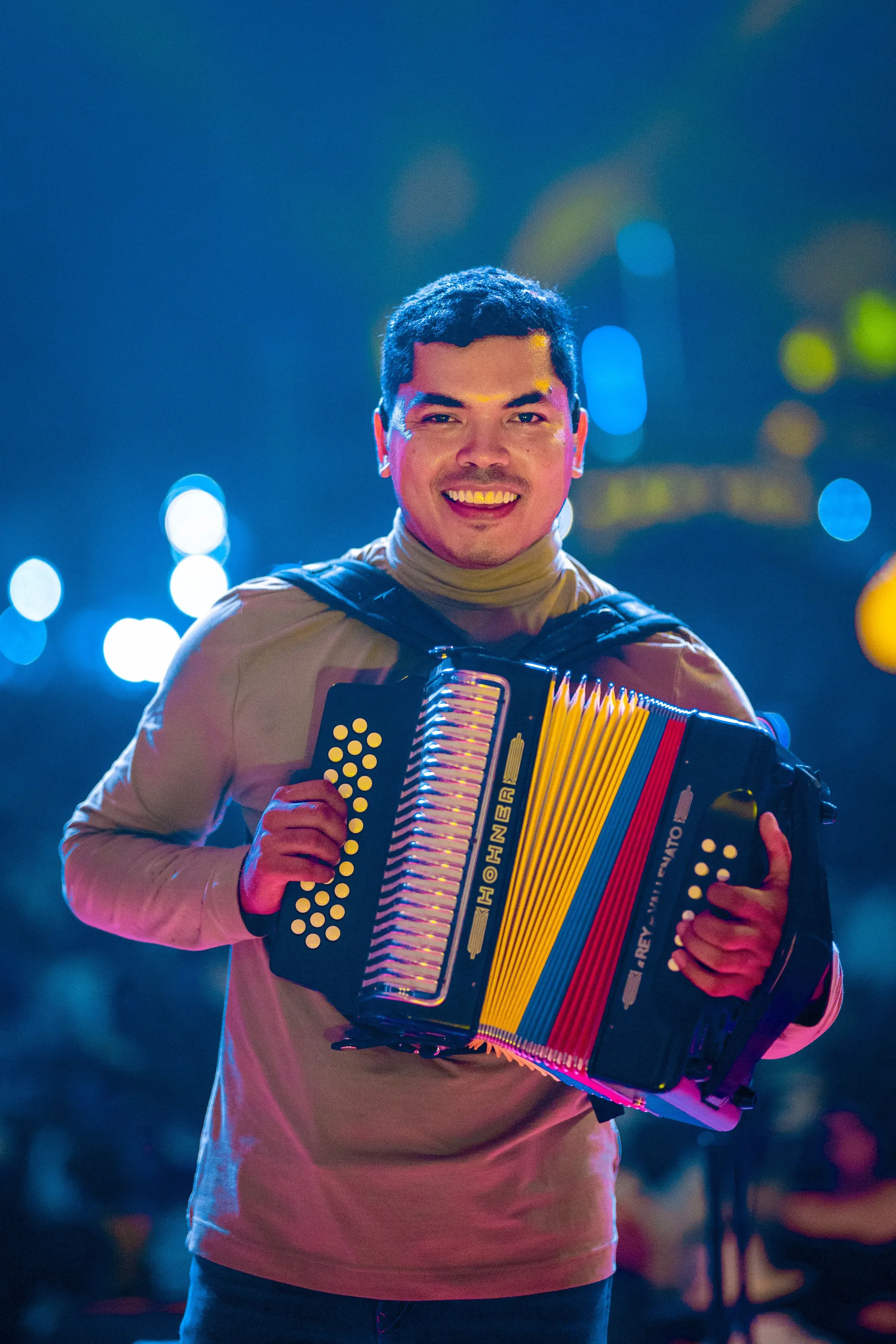
Vallenato is the music you are most likely to hear in Colombia, on buses, in shops, in taxis, and at every family party. It comes from the region around Valledupar, near the Caribbean coast, and its traditional form uses just three instruments: an accordion, a small hand drum called the caja, and the guacharaca, a ribbed wooden stick scraped with a wire comb.
UNESCO, which inscribed traditional vallenato on its list of intangible heritage in need of urgent safeguarding in 2015, describes it as a fusion of the songs of cowherds in the Greater Magdalena region, the chants of enslaved Africans, and the dance rhythms of the Indigenous peoples of the Sierra Nevada de Santa Marta. That mixture of three worlds is a theme you will find all over Colombian culture. The songs are stories: of love, rivalry, regional pride, and the news of the day, carried from town to town by traveling musicians long before radio.
The reason it needs safeguarding is worth knowing. UNESCO points to the armed conflict, to a commercial new wave of vallenato that is pushing the traditional form aside, and to the decline of the street parrandas, the gatherings where the music was passed from one generation to the next. The vallenato you hear on a bus is mostly the modern, romantic kind. The traditional form is still very much alive, but you have to look for it.
The place to look is Valledupar’s Festival de la Leyenda Vallenata, where accordionists compete for the title of Rey Vallenato, the vallenato king. Its organizers have scheduled the 60th edition for April 28 to May 1, 2027.
Cumbia is older, and it is the other great music of the coast. It grew up along the lower Magdalena River and the Caribbean, built from African drums, Indigenous flutes, and Spanish song, and it spread from Colombia across Latin America, where it has been adopted and reinvented from Mexico to Argentina. The traditional sound is carried by the gaitas, long cane flutes with beeswax heads, over drums and a maraca. Watch for the dance too: women in wide skirts, men in white with straw hats, circling each other slowly.
And in Cartagena and the neighborhoods around it, listen for champeta, the city’s own dance music, which mixes Afro-Colombian coastal rhythms with guitar-driven African pop and plays from enormous painted sound systems at street parties.
The Pacific Coast: Marimba and Chants
The Pacific coast, home to a largely Afro-Colombian population, has a musical tradition that sounds like nothing else in the country. Its center is the marimba de chonta, a xylophone made of palm wood with bamboo resonators, played with drums and maracas, under call-and-response singing.
UNESCO inscribed the marimba music, traditional chants, and dances of Colombia’s South Pacific region and Ecuador’s Esmeraldas province on its Representative List in 2015. As it describes, the music is not entertainment set apart from daily life: it accompanies religious festivities, celebrations of saints, and the farewell of the dead, and it is handed down within families and communities, with older people passing on the oral knowledge.
The biggest showcase is Cali’s Petronio Álvarez Festival, normally held in August, which brings musicians from all over the Pacific coast to the city. The 2026 edition did not go ahead as planned; our post on the festival has the latest on its status.
Cali: Salsa
Salsa was not born in Colombia. It took shape in New York and the Caribbean. But no city outside the Caribbean adopted it as completely as Cali, and Caleños will tell you, with justification, that their city is the world capital of salsa.
What makes Cali different is that salsa there is something people do, not just something they hear. The city developed its own fast, acrobatic style of dancing, with intricate footwork, and supports a dense world of dance schools, competitive troupes, clubs, and salsotecas, bars dedicated to playing and listening to old records. Bands like Grupo Niche became the sound of the city, and the Feria de Cali in late December puts salsa at the center of a citywide celebration.
If you want to try it, Cali is the place to take a class. Our guide to dancing in Colombia covers where to learn, and the Cali guide covers the city itself.
The Andes: Bambuco and String Music
In the highlands around Bogotá, Medellín, and the Coffee Region, the traditional music is quieter and older in feel, built around strings. The tiple, a small guitar with twelve strings in four groups of three, is the emblematic instrument of Andean Colombian music, played alongside the guitar and the bandola.
The best-known Andean rhythm is the bambuco, a lilting music in a triple meter that is famously tricky to count, long treated as the musical emblem of the Andean interior. You are less likely to hear it in a bar than vallenato or reggaeton, but you will hear it at cultural events, in folkloric dance performances, and at highland town festivals, often with dancers in the traditional dress of the region.
The Eastern Plains: Joropo and Work Songs
East of the Andes, the Llanos, the vast tropical plains shared with Venezuela, have their own culture of cattle ranching and horsemanship, and their own music. Joropo is fast and virtuosic, played on the harp, the cuatro, a small four-string guitar, and maracas, with a dance of rapid stamping steps.
Older and quieter are the llano work songs, sung a cappella while herding and milking cattle. UNESCO inscribed them in 2017 on its list of heritage in need of urgent safeguarding, as a tradition shared by Colombia and Venezuela. It is music made for animals as much as people, sung by a lone cowhand to the herd, and UNESCO describes the songs as repositories of the individual and collective stories of the llaneros, the people of the plains. The threats it names are familiar: changing land use, migration to the cities, and fading interest among the young.
Medellín: Reggaeton and the Modern Sound
For many people under thirty, the music of Colombia is reggaeton, and its capital is Medellín. Reggaeton started in Puerto Rico and Panama, but Medellín became one of its main centers in the 2010s, and artists from the city, among them J Balvin, Maluma, Karol G, and Feid, went on to global careers. You will hear it in every club in the country.
It sits alongside a broader modern pop that often borrows from the traditions above. Carlos Vives took vallenato to a pop audience in the 1990s, and Shakira, from Barranquilla, has drawn on Colombian and Caribbean rhythms throughout her career. A lot of contemporary Colombian music is exactly this kind of conversation between the old regional sounds and the new.
Where to Hear It on Your Trip
- On the coast, vallenato is in the air everywhere, and Barranquilla’s Carnival, which UNESCO recognized as a masterpiece of intangible heritage in 2003, is the biggest celebration of the coast’s music and dance. It is held over the four days before Lent each year.
- In Cali, take a salsa class and spend an evening at a salsoteca. The dancing is the reason to go.
- In Medellín, reggaeton plays across the nightlife districts, and the city’s music scene goes well beyond it.
- At festivals, the regional traditions are at their best and most traditional. Our guide to Colombia’s festivals has the main ones by region and month.
You do not need to know any of this to enjoy Colombian music. It will find you, probably on a bus at full volume. But knowing that the accordion, the marimba, and the harp each belong to a different Colombia makes the journey between them more interesting.
Sources
- UNESCO: Traditional vallenato music of the Greater Magdalena region
- UNESCO: Marimba music, traditional chants, and dances from the Colombian South Pacific region and Esmeraldas Province of Ecuador
- UNESCO: Colombian-Venezuelan llano work songs
- UNESCO: Carnival of Barranquilla
- La República: the 60th Festival de la Leyenda Vallenata, April 28 to May 1, 2027 (September 11, 2026)
Frequently Asked Questions
What is the traditional music of Colombia?
There is no single one. Colombia's music is regional: vallenato and cumbia on the Caribbean coast, marimba music and chants on the Pacific coast, bambuco and string music in the Andes, joropo and work songs on the eastern plains, and salsa in Cali. UNESCO lists vallenato, Pacific marimba music, and the llano work songs as intangible cultural heritage.
What instruments are used in vallenato?
Three: an accordion, a small hand drum called the caja, and the guacharaca, a ribbed wooden stick scraped with a wire comb. UNESCO inscribed traditional vallenato on its list of heritage in need of urgent safeguarding in 2015.
When is the vallenato festival in Valledupar?
The 60th Festival de la Leyenda Vallenata is scheduled for April 28 to May 1, 2027, according to the foundation that organizes it.
Why is Cali called the salsa capital?
Salsa arrived in Cali from the Caribbean and New York and took root so deeply that the city built its own fast, footwork-heavy style of dancing it. Today Cali has a dense scene of dance schools, clubs, and shows, and salsa is part of everyday social life rather than a nightclub niche.